
Microsoft on Friday disclosed a potential connection between the
Raspberry Robin USB-based worm and an infamous Russian cybercrime
group tracked as Evil Corp.
The tech giant said[1]
it observed the FakeUpdates[2]
(aka SocGholish) malware being delivered via existing Raspberry
Robin infections on July 26, 2022.
Raspberry Robin, also called QNAP Worm, is known[3]
to spread from a compromised system via infected USB devices
containing malicious a .LNK files to other devices in the target
network.
The campaign, which was first spotted by Red Canary in September
2021, has been elusive in that no later-stage activity has been
documented nor has there any concrete link tying it to a known
threat actor or group.
The disclosure marks the first evidence of post-exploitation
actions carried out by the threat actor upon leveraging the malware
to gain initial access to a Windows machine.
“The DEV-0206-associated FakeUpdates activity on affected
systems has since led to follow-on actions resembling DEV-0243
pre-ransomware behavior,” Microsoft noted.
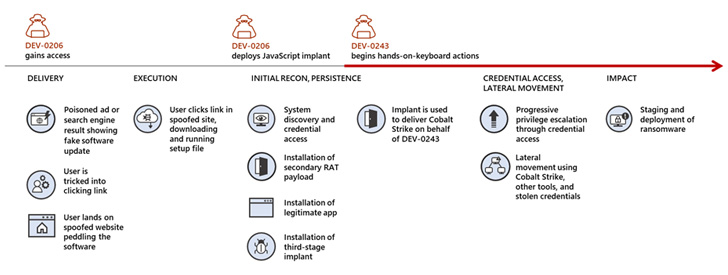
DEV-0206 is Redmond’s moniker for an initial access broker that
deploys a malicious JavaScript framework called FakeUpdates by
enticing targets into downloading fake browser updates.
The malware, at its core, acts as a conduit for other campaigns
that make use of this access purchased from DEV-0206 to distribute
other payloads, primarily Cobalt Strike loaders attributed to
DEV-0243, which is also known as Evil Corp.
Also called Gold Drake and Indrik Spider, the financially
motivated hacking group has historically operated the Dridex
malware and has since switched to deploying a string of ransomware
families over the years, including most recently LockBit[4].
“The use of a RaaS payload by the ‘EvilCorp’ activity group is
likely an attempt by DEV-0243 to avoid attribution to their group,
which could discourage payment due to their sanctioned status,”
Microsoft said.
It’s not immediately clear what exact connections Evil Corp,
DEV-0206, and DEV-0243 may have with one another.
Katie Nickels, director of intelligence at Red Canary, said in a
statement shared with The Hacker News that the findings, if proven
to be correct, fills a “major gap” with Raspberry Robin’s modus
operandi.
“We continue to see Raspberry Robin activity, but we have not
been able to associate it with any specific person, company,
entity, or country,” Nickels said.
“Ultimately, it’s too early to say if Evil Corp is responsible
for, or associated with, Raspberry Robin. The
Ransomware-as-a-Service (RaaS) ecosystem is a complex one, where
different criminal groups partner with one another to achieve a
variety of objectives. As a result, it can be difficult to untangle
the relationships between malware families and observed
activity.”
References
Read more https://thehackernews.com/2022/07/microsoft-links-raspberry-robin-usb.html