A systematic analysis of attacks against Microsoft’s Internet
Information Services (IIS) servers has revealed as many as 14
malware families, 10 of them newly documented, indicating that the
Windows-based web server software continues to be a hotbed for
natively developed malware[1] for close to eight
years.
The findings were presented today by ESET malware researcher
Zuzana Hromcova at the Black Hat USA security conference[2].
“The various kinds of native IIS malware identified are
server-side malware and the two things it can do best is, first,
see and intercept all communications to the server, and second,
affect how the requests are processed,” Hromcova told in an
interview with The Hacker News. “Their motivations range from
cybercrime to espionage, and a technique called SEO fraud.”
IIS is an extensible web server software developed by Microsoft,
enabling developers to take advantage of its modular architecture
and use additional IIS modules to expand on its core
functionality.
“It comes as no surprise that the same extensibility is
attractive for malicious actors – to intercept network traffic,
steal sensitive data or serve malicious content,” according to a
ESET report shared with The Hacker News.
“Moreover, it is quite rare for endpoint (and other) security
software to run on IIS servers, which makes it easy for attackers
to operate unnoticed for long periods of time. This should be
disturbing for all serious web portals that want to protect their
visitors’ data, including authentication and payment
information.”
 |
| IIS malware phases |
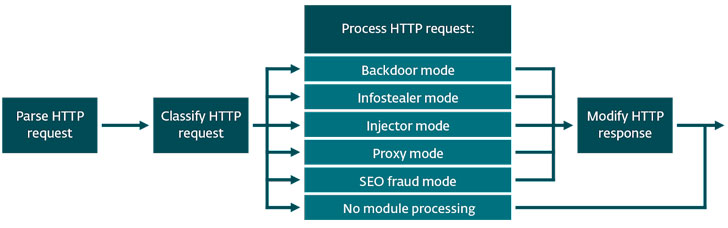
By collecting over 80 malware samples, the study grouped them
into 14 unique families (Group 1 to Group 14), most of which were
first detected between 2018 and 2021 and undergoing active
development to date. While they may not exhibit any connection to
one another, what’s common among all the 14 malware families is
that they are all developed as malicious native IIS modules.
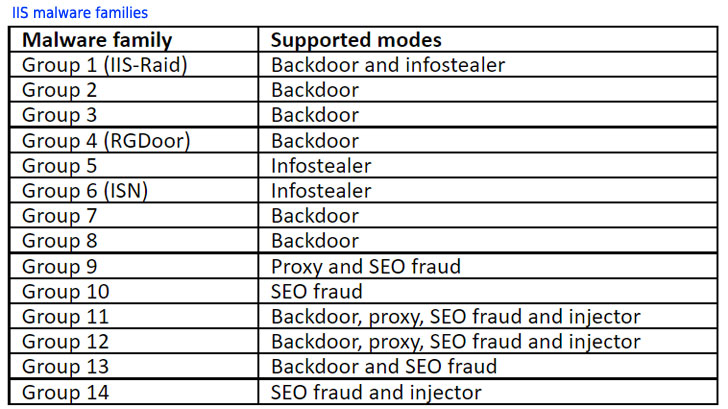
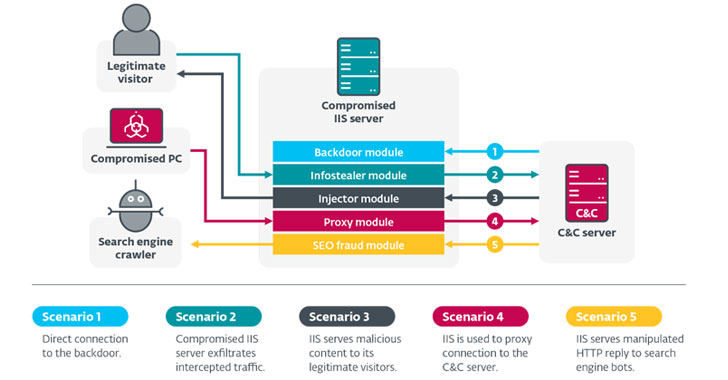
“In all cases, the main purpose of IIS malware is to process
HTTP requests incoming to the compromised server and affect how the
server responds to (some of) these requests – how they are
processed depends on malware type,” Hromcova explained. The malware
families have been found to operate in one of the five modes –
- Backdoor mode – remotely control the
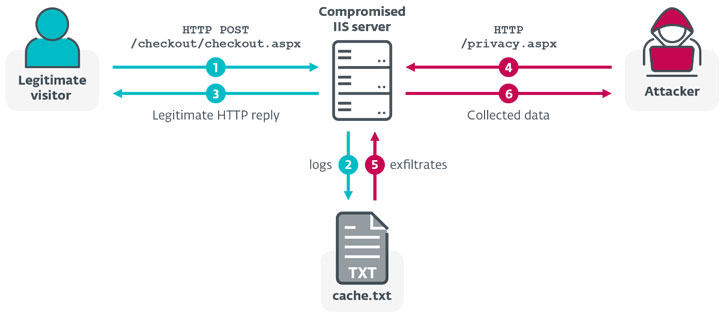
compromised computer with IIS installed - Infostealer mode – intercept regular traffic
between the compromised server and its legitimate visitors, to
steal information such as login credentials and payment
information - Injector mode – modify HTTP responses sent to
legitimate visitors to serve malicious content - Proxy mode – turn the compromised server into
an unwitting part of command-and-control (C2) infrastructure for
another malware family, and relay communication between victims and
the actual C2 server - SEO fraud mode – modify the content served to
search engine crawlers in order to artificially boost ranking for
selected websites (aka doorway pages[3])
Infections involving IIS malware typically hinge on server
administrators inadvertently installing a trojanized version of a
legitimate IIS module or when an adversary is able to get access to
the server by exploiting a configuration weakness or vulnerability
in a web application or the server, using it to install the IIS
module.
 |
| infostealing mechanism |
After Microsoft released out-of-band patches for ProxyLogon[4]
flaws affecting Microsoft Exchange Server 2013, 2016, and 2019
earlier this March, it was not long before multiple advanced
persistent threat (APT) groups joined in the attack frenzy, with
ESET observing[5]
four email servers located in Asia and South America that were
compromised to deploy web shells that served as a channel to
install IIS backdoors.
This is far from the first time Microsoft web server software
has emerged a lucrative target for threat actors. Last month,
researchers from Israeli cybersecurity firm Sygnia disclosed a
series of targeted cyber intrusion attacks undertaken by an
advanced, stealthy adversary known as Praying Mantis[6]
targeting internet-facing IIS servers to infiltrate high-profile
public and private entities in the U.S.
To prevent compromise of IIS servers, it’s recommended to use
dedicated accounts with strong, unique passwords for
administration-related purposes, install native IIS modules only
from trusted sources, reduce the attack surface by limiting the
services that are exposed to the internet, and use a web
application firewall for an extra layer of security.
“One of the most surprising aspects of the investigation is how
versatile IIS malware is, and the [detection of] SEO fraud criminal
scheme, where malware is misused to manipulate search engine
algorithms and help boost the reputation of third-party websites,”
Hromcova said. “We haven’t seen anything like that before.”
References
- ^
natively
developed malware (www.trustwave.com) - ^
Black
Hat USA security conference
(www.blackhat.com) - ^
doorway
pages (developers.google.com) - ^
ProxyLogon
(thehackernews.com) - ^
observing
(thehackernews.com) - ^
Praying
Mantis (thehackernews.com)