
An amalgam of multiple state-sponsored threat groups from China
may have been behind a string of targeted attacks against Russian
federal executive authorities in 2020.
The latest research, published by Singapore-headquartered
company Group-IB, delves into a piece of computer virus called
“Webdav-O” that was detected in the intrusions, with the
cybersecurity firm observing similarities between the tool and that
of popular Trojan called “BlueTraveller[1],” that’s known to be
connected to a Chinese threat group called TaskMasters and deployed
in malicious activities with the aim of espionage and plundering
confidential documents.
“Chinese APTs are one of the most numerous and aggressive hacker
communities,” researchers Anastasia Tikhonova and Dmitry Kupin
said[2]. “Hackers mostly target
state agencies, industrial facilities, military contractors, and
research institutes. The main objective is espionage: attackers
gain access to confidential data and attempt to hide their presence
for as long as possible.”
The report builds on a number of public disclosures in May from
Solar JSOC[3]
and SentinelOne[4], both of which disclosed
a malware called “Mail-O” that was also observed in attacks against
Russian federal executive authorities to access the cloud service
Mail.ru, with SentinelOne tying it to a variant of another
well-known malicious software called “PhantomNet” or “SManager”
used by a threat actor dubbed TA428.
“The main goal of the hackers was to completely compromise the
IT infrastructure and steal confidential information, including
documents from closed segments and email correspondence of key
federal executive authorities,” Solar JSOC noted, adding the
“cybercriminals ensured themselves a high level of secrecy through
the use of legitimate utilities, undetectable malware, and a deep
understanding of the specifics of the work of information
protection tools installed in government bodies.”
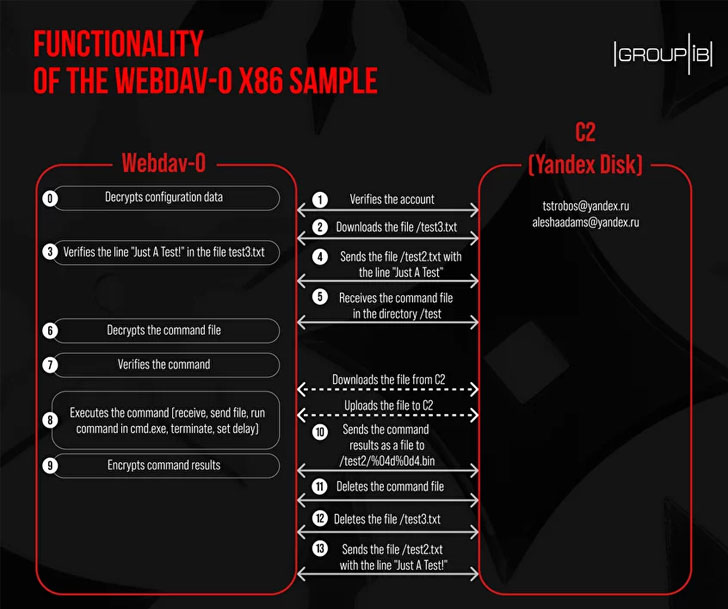
Group-IB’s analysis centers on a Webdav-O sample that was
uploaded to VirusTotal in November 2019 and the overlaps it shares
with the malware sample detailed by Solar JSOC, with the
researchers finding the latter to be a newer, partially improvised
version featuring added capabilities. The detected Webdav-O sample
has also been linked to the BlueTraveller trojan, citing source
code similarities and the manner in which commands are
processed.
What’s more, further investigation into TA428’s toolset has
revealed numerous commonalities between BlueTraveller and a nascent
malware strain named “Albaniiutas[5]” that was attributed to
the threat actor in December 2020, implying that not only is
Albaniiutas an updated variant of BlueTraveller, but also that
Webdav-O malware is a version of BlueTraveller.
“It is noteworthy that Chinese hacker groups actively exchange
tools and infrastructure, but perhaps it is just the case here,”
the researchers said. “This means that one Trojan can be configured
and modified by hackers from different departments with different
levels of training and with various objectives.”
“Either both Chinese hacker groups (TA428 and TaskMasters)
attacked Russian federal executive authorities in 2020 or that
there is one united Chinese hacker group made up of different
units.”
References
- ^
BlueTraveller
(www.ptsecurity.com) - ^
said
(blog.group-ib.com) - ^
Solar
JSOC (rt-solar.ru) - ^
SentinelOne
(labs.sentinelone.com) - ^
Albaniiutas
(malpedia.caad.fkie.fraunhofer.de)