
requirement of an easy-to-use video conferencing app during the
coronavirus pandemic overnight made it one of the most favorite
communication tool for millions of people around the globe.
No doubt, Zoom is an efficient online video meeting solution
that’s helping people stay socially connected during these
unprecedented times, but it’s still not the best choice for
everyone—especially those who really care about their privacy and
security.
According to cybersecurity expert @_g0dmode, the Zoom
video conferencing software for Windows is vulnerable to a classic
‘UNC path injection‘ vulnerability that could allow remote
attackers to steal victims’ Windows login credentials and even
execute arbitrary commands on their systems.
[1]
Such attacks are possible because Zoom for Windows supports remote
UNC paths that convert potentially insecure URIs into hyperlinks
when received via chat messages to a recipient in a personal or
group chat.
Hacking Zoom to Steal Windows Passwords Remotely
Confirmed by researcher Matthew
Hickey[2] and demonstrated by
Mohamed
Baset[3], the first attack
scenario involves the SMBRelay technique that exploits the fact
that Windows automatically exposes a user’s login username and NTLM
password hashes to a remote SMB server when attempting to connect
and download a file hosted on it.
To steal Windows login credentials of a targeted user, all an
attacker needs to do is sent a crafted URL (i.e.,
\\x.x.x.x\abc_file) to a victim via a chat interface.
Once clicked, the attack would eventually allow the
attacker-controlled SMB share to automatically capture
authentication data from Windows, without the knowledge of the
targeted user.
To be noted, the captured passwords are not plaintext; instead,
NTLM hashes of them, but a weak one can easily be cracked in
seconds using password cracking tools like HashCat or John the
Ripper.
In a shared environment, like office space, stolen Windows login
credentials can be reused immediately to compromise other users or
IT resources, and launch further attacks.
Exploiting Zoom to Compromise Windows Systems Remotely
Besides stealing Windows credentials, the flaw can also be
exploited to launch any program already present on a targeted
computer or execute arbitrary commands to compromise it remotely,
confirmed[4] by Google security
researcher Tavis Ormandy.
As shown, Ormandy demonstrated that the UNC path injection flaw
in Zoom can also be exploited to run a batch script—without a
prompt—containing malicious commands when called from the Windows
default download directory.
The second attack scenario relies on the fact that browsers
running on Windows operating system automatically save downloaded
in a default folder, which can be abused to first trick a user into
downloading the batch script and then triggering it using the zoom
bug.
To be noted, to exploit this issue, an attacker must be aware of
the Windows username for the targeted user, which, however, can
easily be obtained using the first SMBRelay attack.
What Should Zoom Users Do?
Zoom has already been notified of this bug, but since the flaw has
not yet been patched, users are advised to either use an
alternative video conferencing software or Zoom in their web
browsers instead of installing a dedicated client app on their
systems.
Some of the best alternative video conferencing and chat
software are:
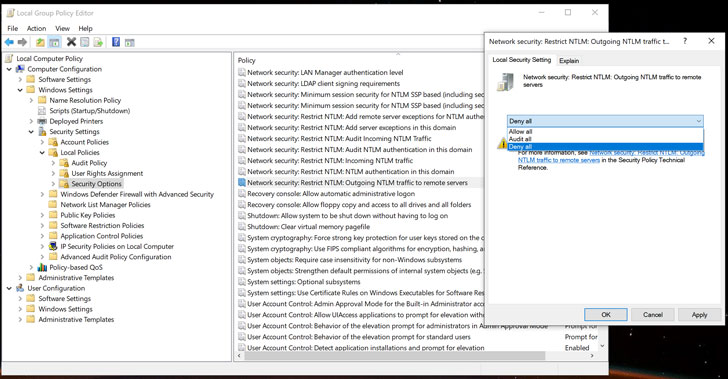
security policy
settings[9] to restrict the
operating system from automatically passing their NTML credentials
to a remote SMB server.
More Zoom-related Security and Privacy Incidents
This is not the only issue to have been uncovered in Zoom video
conferencing software over the past couple of days, raising privacy
and security concerns among millions of users.
The FBI is warning zoom users of the “Zoom-Bombing[10]” attack after some
people find a way to sneak their way into unsuspecting meetings and
online gatherings and bombarded them with pornographic images or
racist comments.
Just yesterday, another report confirmed that Zoom doesn’t use
end-to-end encryption[11] to protect calling data
of its users from prying eyes despite telling users that “Zoom is
using an end to end encrypted connection.”
Last week, Zoom updated its iOS app after it was caught sharing
users’ device information with Facebook, raising legitimate
concerns over users’ privacy.
Earlier this year, Zoom also patched another privacy
bug in its software that could have let uninvited people join
private meetings and remotely eavesdrop on private audio, video,
and documents shared throughout the session.
[12]
References
- ^
@_g0dmode
(twitter.com) - ^
Matthew Hickey
(twitter.com) - ^
Mohamed Baset
(twitter.com) - ^
confirmed
(twitter.com) - ^
Skype
(www.skype.com) - ^
Google Hangouts Meet
(gsuite.google.com) - ^
Jitsi
(meet.jit.si) - ^
Signal
(signal.org) - ^
security policy settings
(docs.microsoft.com) - ^
Zoom-Bombing
(www.fbi.gov) - ^
Zoom doesn’t use end-to-end
encryption (theintercept.com) - ^
another privacy bug
(thehackernews.com)
Read more http://feedproxy.google.com/~r/TheHackersNews/~3/tGezqi3DLXY/zoom-windows-password.html