
A newly discovered botnet capable of staging distributed
denial-of-service (DDoS) attacks targeted unpatched Ribbon
Communications (formerly Edgewater Networks) EdgeMarc appliances
belonging to telecom service provider AT&T by exploiting a
four-year-old flaw in the network appliances.
Chinese tech giant Qihoo 360’s Netlab network security division,
which detected the botnet first on October 27, 2021, called it
EwDoor, noting it observed 5,700 compromised IP
addresses located in the U.S. during a brief three-hour window.
“So far, the EwDoor in our view has undergone three versions of
updates, and its main functions can be summarized into two main
categories of DDoS attacks and backdoor,” the researchers noted[1]. “Based on the attacked
devices are telephone communication related, we presume that its
main purpose is DDoS attacks, and gathering of sensitive
information, such as call logs.”
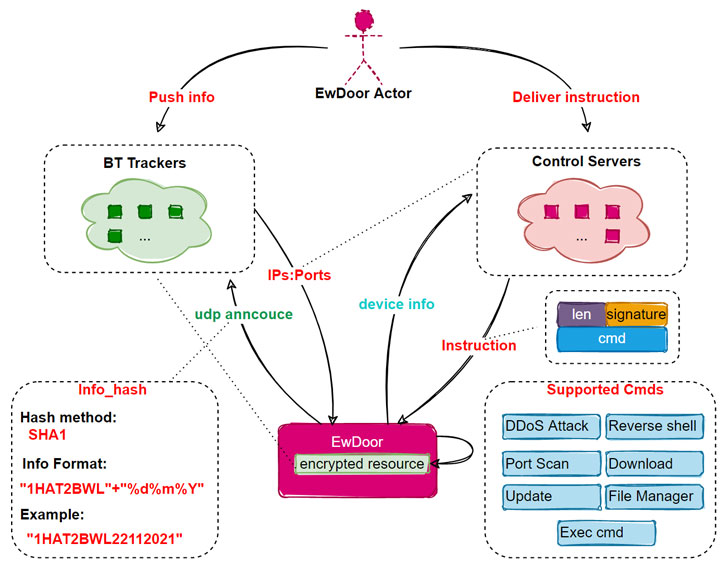
Propagating through a flaw in EdgeMarc devices, EwDoor supports
a variety of features, including the ability to self-update,
download files, obtain a reverse shell on the compromised machine,
and execute arbitrary payloads. The vulnerability in question is
CVE-2017-6079[2]
(CVSS score: 9.8), a command injection flaw affecting the session
border controllers that could be weaponized to execute malicious
commands.
EwDoor, besides gathering information about the infected system,
also establishes communications with a remote command-and-control
(C2) server, either directly or indirectly using BitTorrent
Trackers to fetch the C2 server IP address, to await further
commands issued by the attackers.
We have reached out to AT&T for comment, and we will update
the story when we hear back. Additional indicators of compromise
associated with the campaign can be accessed here[3].
References
Read more https://thehackernews.com/2021/12/new-ewdoor-botnet-targeting-unpatched.html