Three different state-sponsored threat actors aligned with
China, India, and Russia have been observed adopting a new method
called RTF[1]
(aka Rich Text Format) template injection as part of their phishing
campaigns to deliver malware to targeted systems.
“RTF template injection is a novel technique that is ideal for
malicious phishing attachments because it is simple and allows
threat actors to retrieve malicious content from a remote URL using
an RTF file,” Proofpoint researchers said in a new report[2]
shared with The Hacker News.
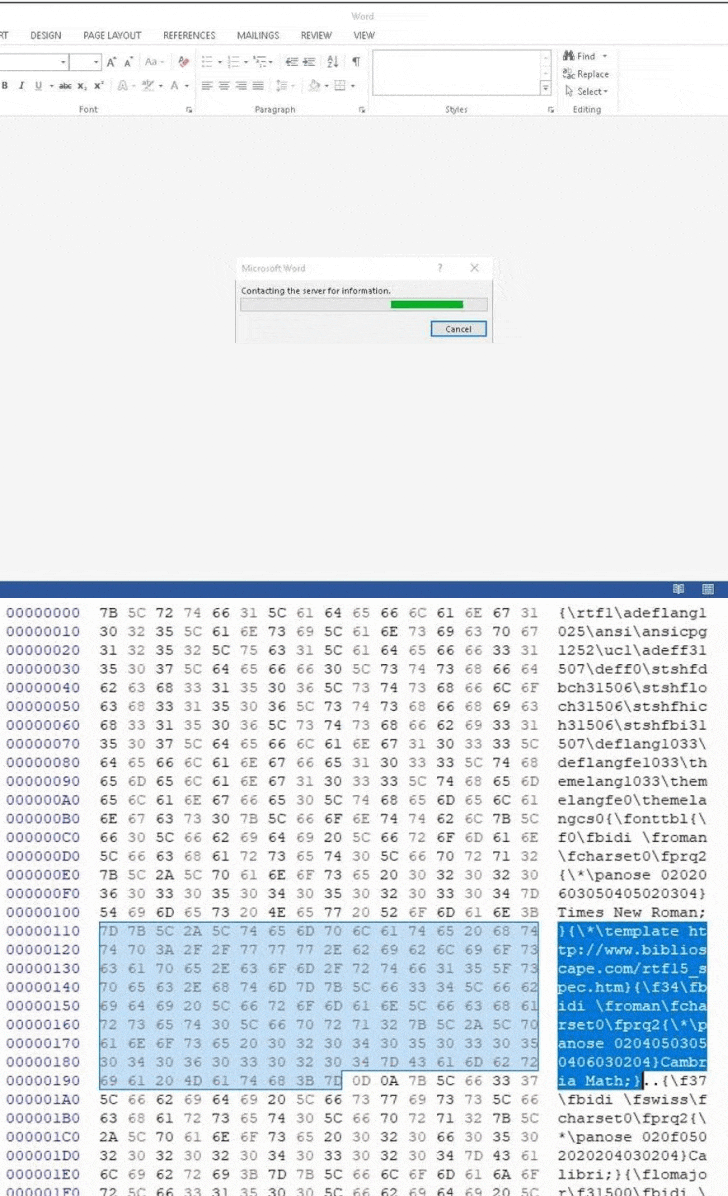
At the heart of the attack is an RTF file containing decoy
content that can be manipulated[3]
to enable the retrieval of content, including malicious payloads,
hosted at an external URL upon opening an RTF file. Specifically,
it leverages the RTF template functionality[4]
to alter a document’s formatting properties using a hex
editor[5] by specifying a URL
resource instead of an accessible file resource destination from
which a remote payload may be retrieved.
Put differently, the idea is that attackers can send malicious
Microsoft Word documents to targeted victims that appear entirely
innocuous but are designed to load malicious code via the template
feature remotely.
Thus when an altered RTF file is opened via Microsoft Word, the
application will proceed to download the resource from the
specified URL prior to displaying the lure content of the file.
It’s therefore not surprising that the technique is being
increasingly weaponized by threat actors to distribute malware.
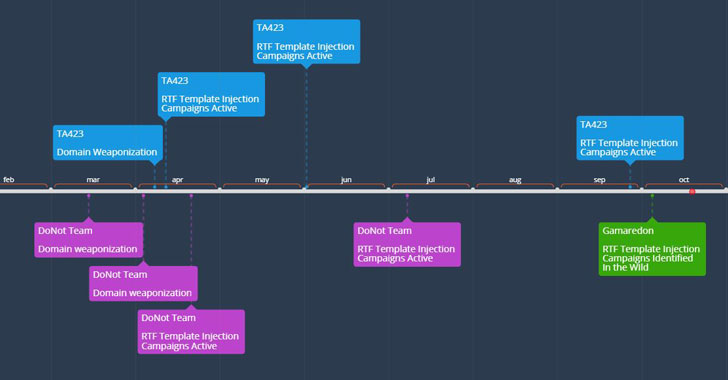
Proofpoint said it observed Template injection RTF files linked
to the APT groups DoNot Team[6], Gamaredon, and a
Chinese-related APT actor dubbed TA423 as early as February 2021,
with the adversaries utilizing the files to target entities in
Pakistan, Sri Lanka, Ukraine, and those operating in the deep water
energy exploration sector in Malaysia via defense-themed and other
country-specific lures.
While the DoNot Team has been suspected of carrying out cyber
attacks that are aligned with Indian-state interests, Gamaredon was
recently outed[7]
by Ukrainian law enforcement as members of Russia’s Federal
Security Service (FSB) with a propensity for striking the public
and private sector in the country for harvesting classified
information from compromised Windows systems for geopolitical
gains.
“The innovation by threat actors to bring this method to a new
file type in RTFs represents an expanding surface area of threat
for organizations worldwide,” the researchers said. “While this
method currently is used by a limited number of APT actors with a
range of sophistication, the technique’s effectiveness combined
with its ease of use is likely to drive its adoption further across
the threat landscape.”
References
- ^
RTF
(en.wikipedia.org) - ^
report
(www.proofpoint.com) - ^
manipulated
(fareedfauzi.github.io) - ^
template
functionality (attack.mitre.org) - ^
hex
editor (en.wikipedia.org) - ^
DoNot
Team (thehackernews.com) - ^
recently
outed (thehackernews.com)
Read more https://thehackernews.com/2021/12/hackers-increasingly-using-rtf-template.html