
In a report shared with The Hacker News today, Check Point
researchers disclosed details about a critical
vulnerability[1] in Instagram’s
Android app that could have allowed remote attackers to take
control over a targeted device just by sending victims a specially
crafted image.
What’s more worrisome is that the flaw not only lets attackers
perform actions on behalf of the user within the Instagram
app—including spying on victim’s private messages and even deleting
or posting photos from their accounts—but also execute arbitrary
code on the device.
According to an advisory[2] published by
Facebook, the heap overflow security issue (tracked as
CVE-2020-1895, CVSS score: 7.8) impacts all versions of the
Instagram app prior to 128.0.0.26.128, which was released on
February 10 earlier this year.
“This [flaw] turns the device into a tool for spying on targeted
users without their knowledge, as well as enabling malicious
manipulation of their Instagram profile,” Check Point Research said
in an analysis
published[3] today.
“In either case, the attack could lead to a massive invasion of
users’ privacy and could affect reputations — or lead to security
risks that are even more serious.”
After the findings were reported to Facebook, the social media
company addressed the issue with a patch update released six months
ago. The public disclosure was delayed all this time to allow the
majority of Instagram’s users to update the app, thereby mitigating
the risk this vulnerability may introduce.
Although Facebook confirmed there were no signs that this bug
was exploited globally, the development is another reminder of why
it’s essential to keep apps up to date and be mindful of the
permissions granted to them.
A Heap Overflow Vulnerability
According to Check Point, the memory corruption vulnerability
allows for remote code execution that, given Instagram’s extensive
permissions to access a user’s camera, contacts, GPS, photo
library, and microphone, could be leveraged to perform any
malicious action on the infected device.
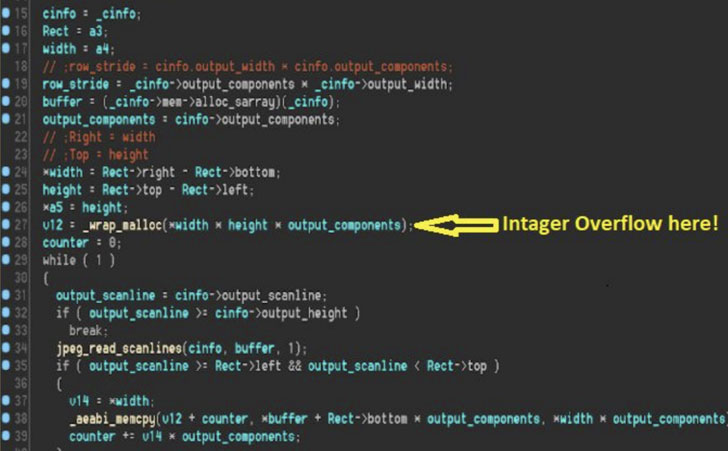
As for the flaw itself, it stems from the way Instagram
integrated MozJPEG[4] — an open-source
JPEG encoder library which aims to lower bandwidth and provide
better compression for images uploaded to the service — resulting
in an integer overflow when the vulnerable function in question
(“read_jpg_copy_loop”) attempts to parse a malicious image with
specially crafted dimensions.
In doing so, an adversary could gain control over the size of
the memory allocated to the image, the length of the data to be
overwritten, and lastly, the contents of the overflowed memory
region, in turn giving the attacker the ability to corrupt specific
locations in a heap and divert code execution.
The consequence of such a vulnerability is that all a bad actor
needs to do is send a corrupted JPEG image to a victim via email or
WhatsApp. Once the recipient saves the image to the device and
launches Instagram, the exploitation takes place automatically,
granting the attacker full control over the app.
Even worse, the exploit can be used to crash a user’s Instagram
app and render it inaccessible unless it’s removed and reinstalled
all over again on the device.
If anything, the vulnerability is indicative of how
incorporating third-party libraries into apps and services can be a
weak link for security if the integration is not done right.
“Fuzzing the exposed code turned up some new vulnerabilities
which have since been fixed,” Check Point’s Gal Elbaz said. “It is
likely that, given enough effort, one of these vulnerabilities can
be exploited for RCE in a zero-click attack scenario.
“Unfortunately, it is also likely that other bugs remain or will
be introduced in the future. As such, continuous fuzz-testing of
this and similar media format parsing code, both in operating
system libraries and third-party libraries, is absolutely
necessary.”
Yaniv Balmas, the head of cyber research at Check Point,
provided the following safety tips for smartphone users:
- Update! Update! Update! Make sure you
regularly update your mobile application and your mobile operating
systems. Dozens of critical security patches are being shipped out
in these updates every week, and each one can potentially have a
severe impact on your privacy. - Monitor permissions. Pay better attention
to applications asking for permission. It’s effortless for app
developers to ask the users for excessive permissions, and it’s
also very easy for users to click ‘Allow’ without thinking
twice. - Think twice about approvals. Take a few
seconds to think before you approve anything. Ask: “do I really
want to give this application this kind of access, do I really need
it?” if the answer is no, DO NOT APPROVE.
References
- ^
critical vulnerability
(www.facebook.com) - ^
advisory
(m.facebook.com) - ^
analysis published
(blog.checkpoint.com) - ^
MozJPEG
(github.com)
Read more http://feedproxy.google.com/~r/TheHackersNews/~3/YCGp09U2wBg/instagram-android-hack.html