malware campaign that has been active since 2016 and was first publicly
reported in August 2018.
Dubbed “ViceLeaker” by researchers at Kaspersky, the
campaign has recently been found targeting Israeli citizens and
some other middle eastern countries with a powerful surveillance
malware designed to steal almost all accessible information,
including call recordings, text messages, photos, videos, and
location data—all without users’ knowledge.
Besides these traditional spying functionalities, the malware
also has backdoor capabilities including upload, download, and
delete files, record surrounding audio, takeover camera, and make
calls or send messages to specific numbers.
The malware used in these campaigns was named “Triout” in a
report published by
Bitdefender in 2018, which is sort of a malware framework that
attackers are using to turn legitimate applications into spyware by
injecting an additional malicious payload into them.
In a new
report[3] published today,
Kaspersky Lab revealed that attackers are actively using the
Baksmali tool to disassemble and then reassemble the code of a
legitimate app after injecting their malicious code in it—a
technique commonly known as Smali injection.
“Based on our detection statistics, the main infection vector is
the spread of Trojanized applications directly to victims via
Telegram and WhatsApp messengers,” the researchers said.
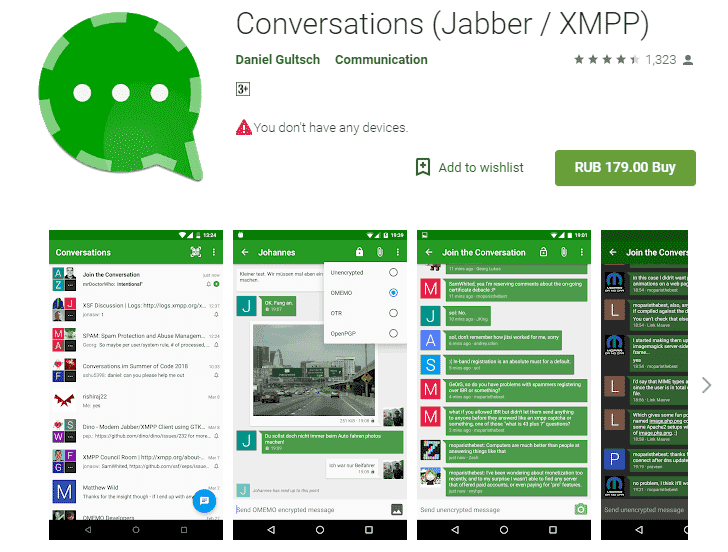
malware to parse commands from the command-and-control server
resembles with modified versions of an open source XMPP/Jabber
client for the Android platform called “Conversations.”
“In addition, we did not see traces of the Smali injection [in the
modified Conversations app],” Kaspersky researchers explained, but
“found traces of dx/dexmerge compilers, which means that, this
time, the attackers just imported the original source code into an
Android IDE (such as Android Studio, for instance) and compiled it
with their own modifications.”
contain any malicious code but appear to be used by the same group
of attackers for some yet-undiscovered purpose.
“This brought to us the hypothesis that this might be the version
used by the group behind ViceLeaker for internal communication or
for other, unclear purposes. All the detection of this backdoored
app were geolocated in Iran,” researchers said.
still ongoing, and attackers could potentially distribute malicious
repackaged versions of legitimate apps through third-party app
stores, instant messengers, or attacker-controlled online webpages.
Since such apps masquerade as legitimate or popular apps,
Android users are highly recommended to always download apps from
trusted sources, like Google Play Store, to prevent themselves from
becoming a victim to this attack.
However, you should also not trust every app available on the
Play Store. So, always stick to only verified developers to avoid
installing malicious apps.
References
- ^
first publicly reported
(thehackernews.com) - ^
report published by Bitdefender
(thehackernews.com) - ^
new report
(securelist.com)
Read more http://feedproxy.google.com/~r/TheHackersNews/~3/mut1Txuogh4/android-malware-hacking.html