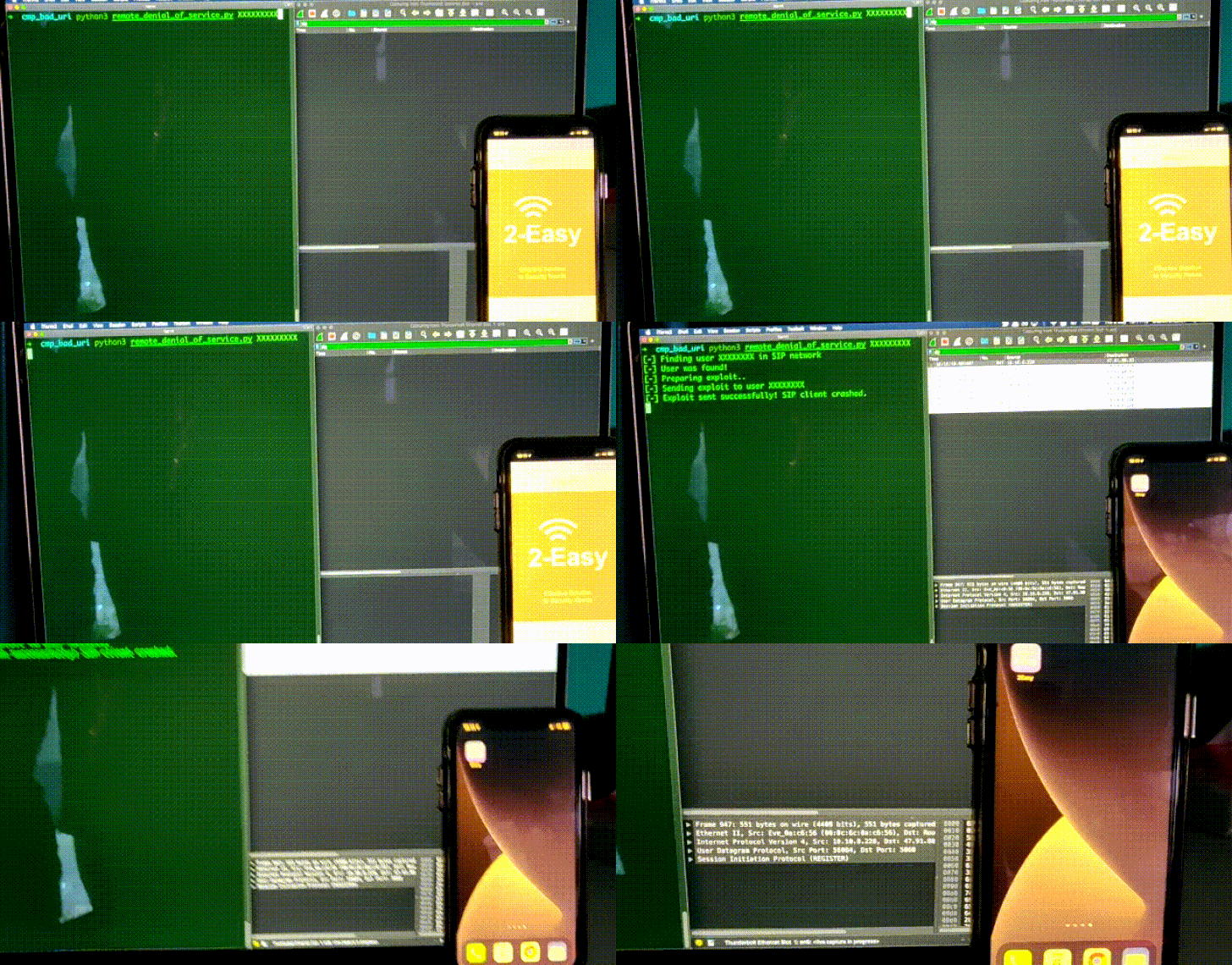
Cybersecurity researchers on Tuesday disclosed details about a
zero-click security vulnerability in Linphone Session Initiation
Protocol (SIP[1]) stack that could be
remotely exploited without any action from a victim to crash the
SIP client and cause a denial-of-service (DoS) condition.
Tracked as CVE-2021-33056[2]
(CVSS score: 7.5), the issue concerns a NULL pointer dereference
vulnerability in the “belle-sip[3]” component, a C-language
library used to implement SIP transport, transaction, and dialog
layers, with all versions prior to 4.5.20[4]
affected by the flaw. The weakness was discovered and reported by
industrial cybersecurity company Claroty.
Linphone is an open-source and cross-platform SIP client with
support for voice and video calls, end-to-end encrypted messaging,
and audio conference calls, among others. SIP, on the other hand,
is a signaling protocol used for initiating, maintaining, and
terminating real-time multimedia communication sessions for voice,
video, and messaging applications over the internet.
To that end, the remotely exploitable vulnerability can be
activated by adding a malicious forward slash (“</”) to a SIP
message header such as To (the call recipient),
From[5]
(initiator of the call), or Diversion[6]
(redirect the destination endpoint), resulting in a crash of the
SIP client application that uses the belle-sip library to handle
and parse SIP messages.
“The underlying bug here is that non-SIP URIs are accepted as
valid SIP header values,” Claroty researcher Sharon Brizinov
said[7]
in a write-up. “Therefore, a generic URI such as a simple single
forward slash will be considered a SIP URI. This means that the
given URI will not contain a valid SIP scheme (scheme will be
NULL), and so when the [string] compare function is called with the
non-existent scheme (NULL), a null pointer dereference will be
triggered and crash the SIP client.”
It’s worth noting that the flaw is also a zero-click
vulnerability as it’s possible to cause the SIP client to crash
simply by sending an INVITE SIP request with a specially-crafted
From/To/Diversion header. As a consequence, any application that
uses belle-sip to analyze SIP messages will be rendered unavailable
upon receiving a malicious SIP “call.”
Although the patches are available for the core protocol stack,
it’s essential that the updates are applied downstream by vendors
that rely on the affected SIP stack in their products.
“Successful exploits targeting IoT vulnerabilities have
demonstrated they can provide an effective foothold onto enterprise
networks,” Brizinov said. “A flaw in a foundational protocol such
as the SIP stack in VoIP phones and applications can be especially
troublesome given the scale and reach shown by attacks against
numerous other third-party components used by developers in
software projects.”
References
Read more http://feedproxy.google.com/~r/TheHackersNews/~3/xH931z1FQJo/linphone-sip-stack-bug-could-let.html