
Threat actors are capitalizing on the growing popularity of
proxyware platforms like Honeygain and Nanowire to monetize their
own malware campaigns, once again illustrating how attackers are
quick to repurpose and weaponize legitimate
platforms[1] to their advantage.
“Malware is currently leveraging these platforms to monetize the
internet bandwidth of victims, similar to how malicious
cryptocurrency mining attempts to monetize the CPU cycles of
infected systems,” researchers from Cisco Talos said[2]
in a Tuesday analysis. “In many cases, these applications are
featured in multi-stage, multi-payload malware attacks that provide
adversaries with multiple monetization methods.”
Proxyware, also called internet-sharing applications, are
legitimate services that allow users to carve out a percentage of
their internet bandwidth for other devices, often for a fee,
through a client application offered by the provider, enabling
other customers to access the internet using the internet
connections offered by nodes on the network. For consumers, such
services are “advertised as a means to circumvent geolocation
checks on streaming or gaming platforms while generating some
income for the user offering up their bandwidth,” the researchers
explained.
But the illicit use of proxyware also introduces a multitude of
risks in that they could permit threat actors to obfuscate the
source of their attacks, thereby not only giving them the ability
to perform malicious actions by making it appear as if they are
originating from legitimate residential or corporate networks, but
also render ineffective conventional network defenses that rely on
IP-based blocklists.
“The same mechanisms currently used to monitor and track Tor
exit nodes, “anonymous” proxies, and other common traffic
obfuscation techniques do not currently exist for tracking nodes
within these proxyware networks,” the researchers noted.
That’s not all. Researchers identified several techniques
adopted by bad actors, including trojanized proxyware installers
that allow for stealthy distribution of information stealers and
remote access trojans (RATs) without the victims’ knowledge. In one
instance observed by Cisco Talos, attackers were found using the
proxyware applications to monetize victims’ network bandwidth to
generate revenue as well as exploit the compromised machine’s CPU
resources for mining cryptocurrency.
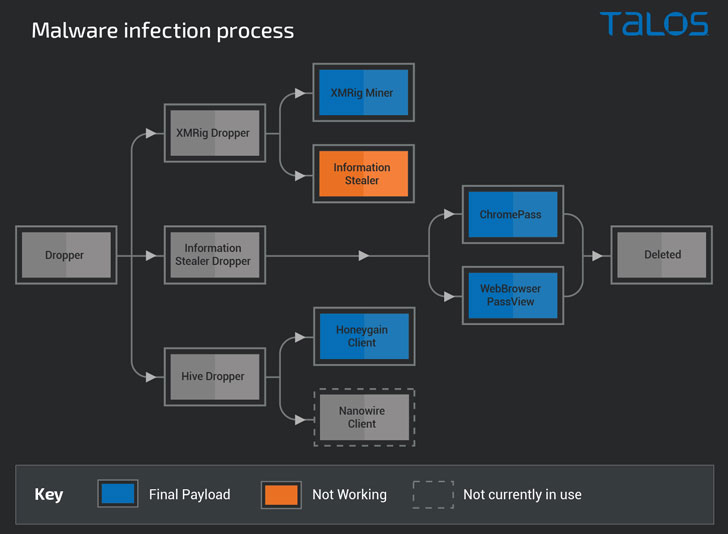
Another case involved a multi-stage malware campaign that
culminated in the deployment of an info-stealer, a cryptocurrency
mining payload, as well as proxyware software, underscoring the
“varied approaches available to adversaries,” who can now go beyond
cryptojacking to also plunder valuable data and monetize successful
infections in other ways.
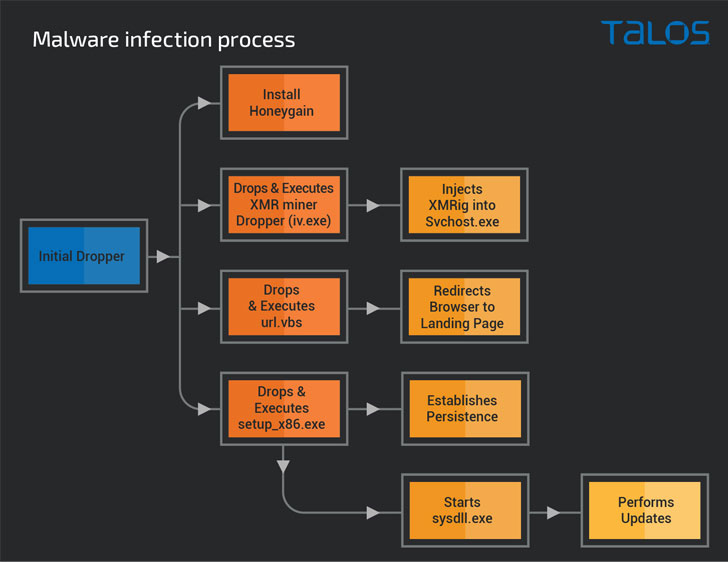
Even more concerningly, researchers detected malware that was
used to silently install Honeygain on infected systems, and
register the client with the adversary’s Honeygain account to
profit off the victim’s internet bandwidth. This also means that an
attacker can sign up for multiple Honeygain accounts to scale their
operation based on the number of infected systems under their
control.
“For organizations, these platforms pose two essential problems:
The abuse of their resources, eventually being blocklisted due to
activities they don’t even control and it increases organizations’
attack surface, potentially creating an initial attack vector
directly on the endpoint,” the researchers concluded. “Due to the
various risks associated with these platforms, it is recommended
that organizations consider prohibiting the use of these
applications on corporate assets.”
References
- ^
repurpose and weaponize legitimate
platforms (thehackernews.com) - ^
said
(blog.talosintelligence.com)