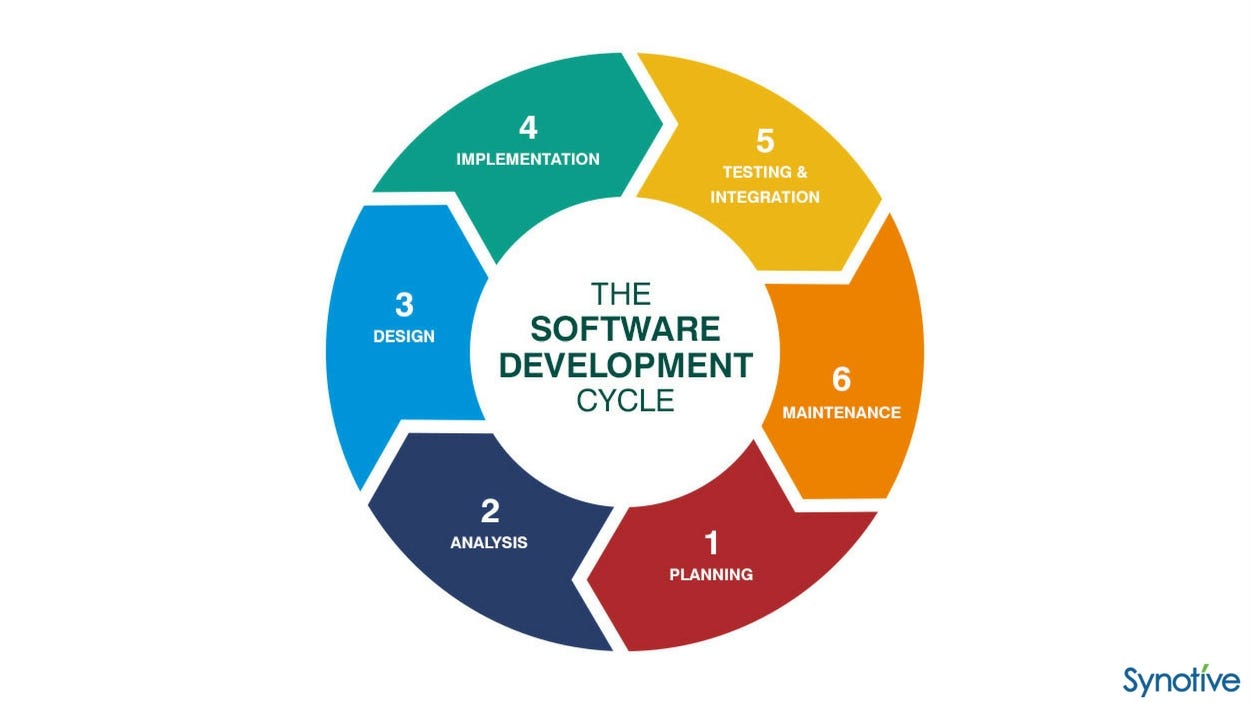
SOFTWARE DEVELOPMENT LIFECYCLE (SDLC)
The software development lifecycle has the following typical phases (note that this is not exact in the CBK and many methodologies/phases may overlap):
Planning/initiation – creation of project, includes scope, budget/cost, objectives, strategies, and schedules.
Functional requirements definition – security controls and compliance defined. Functional requirements as well.
System design specifications – designing the software and architecture, outputs, data flows and interfaces.
Development – development of the source code.
Acceptance – testing the system to make sure it performs within the environment. May be part of the certification and accreditation process. Can include subphases such as:
Testing/evaluation of controls – formal testing processes occur, such as choosing test data, includes fuzzy testing (unexpected data), data validation, bounds checking, and sanitizing any production data.
Certification/Accreditation – AKA authorization to put the system into production. Certification is the technical analysis of system controls. Accreditation is the authorizing official sign-off to put the system into production.
Transition to production/implementation – moving from the acceptance phase into production. This phase includes training and awareness, accreditation, installation, parallel operations with an old system that is being replaced.
Revision/replacement – periodic evaluations for flaws and revisions, and to replace any faulty components that have or could cause security incidents.
Maintenance/operation – system usage across the enterprise. System performance monitoring, regular change management process, backup and recovery procedures, risk analysis that accompanies recertification/accreditation (due to a relocation, change in data classification, or major system change).
We have a pneumonic to help you remember these phases. If you put them together it’s a jumbled mess of PFSDATCTRM. You’ve all heard the saying that “the way to a man’s heart is through his stomach”, so we came up with this: “Please fry some dead animals to catch the right man.”
The system lifecycle (SLC) has two phases after the SDLC completes: 1) Operations and maintenance support, post-installation. And 2) Decommissioning and disposal and system replacement.
The software environment encompasses the spectrum or scope of an application’s reach, from beginning to end of life, to the people who develop and use it. For example, a government agency who creates and updates software for a mainframe that’s hosted onsite and only used by that agency doesn’t have a very large software environment. On the other hand, a COTS product that is used by Macbooks for video and audio editing and sourced from public code repositories has a much larger software environment. Such an environment would include where the code came from, who further developed it, who the customers are, and the environment of the Macbook creators. It could also include firmware and drivers for any hardware that supports video and audio editing, along with their respective developers and customers.
During a system’s design and development is when developers will have the best opportunity to address potential exploitable vulnerabilities that might be inadvertently added to a system and thus more difficult to remove during test and security assessment.
Risk control factors are at their highest point once software has made its way into the hands of users.
Effective security in system development is achieved by:
Statements of purpose/requirements → shaped into detailed system specifications → embodies business logic → guides testing efforts → shapes the user procedures, workflows, and training.
Inverse relationship between Development Time and Error Impact:
This section presented some strange wording that you might need to be aware of. Basically if security alarm thresholds are too high – this means that a lot are being prevented from alerting – then you risk a security incident happening, or being undetected. If security alarm thresholds are too low – this means that a lot (too many) are being allowed to send alerts – then you risk not getting any work done. Management needs to help determine the risk appetite for all projects in order to manage this.
Simple Waterfall SDLC
This is the phased approach to software development where one phase must be completed before the next one starts. Simple mistakes made at each phase (of any development methodology) can lead to exploitable vulnerabilities down the road. The phases of waterfall are:
Concept or mission needs identification
Requirements definition
Systems design
Software and data systems coding
Unit, subsystem, and systems testing
Acceptance testing
Deployment to operational use
Benefit of waterfall is that it ensures that phases are done diligently. Downfall is that phases cannot work on their portion concurrently and thus slows progress. Business value is not demonstrated until the end of a project.
What is SDLC?

SDLC may stand for either the System Development Life Cycle or the Software Development Life Cycle. The author typically refers to them as the System SDLC or Software SDLC for simplicity.
- A system is a collection of related elements or components that work together to achieve a common purpose.
- A life cycle is a collection of predefined stages and processes.
Information System
- Information is useful data, or data with meaning, relevance, and purpose.
- An information system typically comprises components such as 1) data, 2) computer systems, 3) operating systems, 4) software, 5) networks, 6) data centers, 7) people, 8) business processes, and so forth.
- An information system and its components are either bought or made. Security engineering addresses security concerns across the system development life cycle (SDLC).
- This post introduces the Peacock Model as a metaphor for the information system.

Software
- Software is a collection of computer instructions and data organized in a logical way to solve problems.
- It exists in either the text-based script or binary-based machine code; the binaries entail the process of compiling the text-based source code to the binary-based executable.
- A program is the generic term of a script or executable that persisted in the storage. When a program is loaded into the memory and executed by the processor, the program becomes a process.
- Software used to solve business problems is typically called applications.
Systems Engineering
Systems Engineering is a discipline of applying knowledge to create or acquire a system that is composed of interrelated elements collaborating for a common purpose throughout the system development life cycle (SDLC), or system life cycle (SLC).
- NIST SP 800-64 R2 proposes the NIST SDLC in terms of information systems. It is superseded by NIST SP 800-160 V1, which aligns with the more generic SDLC defined by ISO 15288. However, the author believes the legacy NIST SDLC still plays an important role in the CISSP exam. NIST SP 800-160 V1 is crucial to ISSEP.
- ISO 15288 is a standard of Systems and software engineering — System life cycle processes. It applies to both systems and software engineering.

Security Engineering
Security Engineering is a specialty discipline of systems engineering. It addresses the protection needs or security requirements throughout the system life cycle.

Software Development
- The Software SDLC was as long as the period of the project taking months or years in the traditional waterfall model. However, it is much shorter nowadays. The life cycle is as short as an Agile iteration or Scrum sprint of weeks.
- The life cycles are iterated or conducted repeatedly. In Agile, an iteration or sprint typically completes a life cycle that shall deliver the committed scope of software (or values/increment).
- The life cycle in software development varies. There are many well-known methodologies and approaches available. However, the ISC2 official courseware, study guide, and even the CBK propose their software SDLC. We can just choose one out of them to develop software. ISO 15288 is also applicable to software development if you want.
- However, when it comes to information systems, the NIST SDLC (system SDLC) can be treated as the standard for CISSP aspirants.
