A new data wiper malware has been observed deployed against an
unnamed Ukrainian government network, a day after destructive cyber
attacks struck multiple entities in the country preceding the start
of Russia’s military invasion.
Slovak cybersecurity firm ESET dubbed the new malware “IsaacWiper[1],” which it said was
detected on February 24 in an organization that was not affected by
HermeticWiper[2]
(aka FoxBlade), another data wiping malware that targeted several
organizations on February 23 as part of a sabotage operation aimed
at rendering the machines inoperable.
Further analysis of the HermeticWiper attacks, which infected at
least five Ukrainian organizations, have revealed a worm
constituent that propagates the malware across the compromised
network and a ransomware module that acts as a “distraction from
the wiper attacks,” corroborating a prior report[3]
from Symantec.
“These destructive attacks leveraged at least three components:
HermeticWiper for wiping the data, HermeticWizard for spreading on
the local network, and HermeticRansom acting as a decoy
ransomware,” the company said.
In a separate analysis of the new Golang-based ransomware,
Russian cybersecurity company Kaspersky, which codenamed the
malware “Elections GoRansom,” characterized[4]
it as a last-minute operation, adding it was “likely used as a
smokescreen for the HermeticWiper attack due to its
non-sophisticated style and poor implementation.”
As an anti-forensic measure, HermeticWiper is also designed to
hinder analysis by erasing itself from the disk by overwriting its
own file with random bytes.
ESET said it did not find “any tangible connection” to attribute
these attacks to a known threat actor, with the malware artifacts
implying that the intrusions had been planned for several months,
not to mention the fact that the targeted entities suffered
compromises well in advance to the wiper’s deployment.
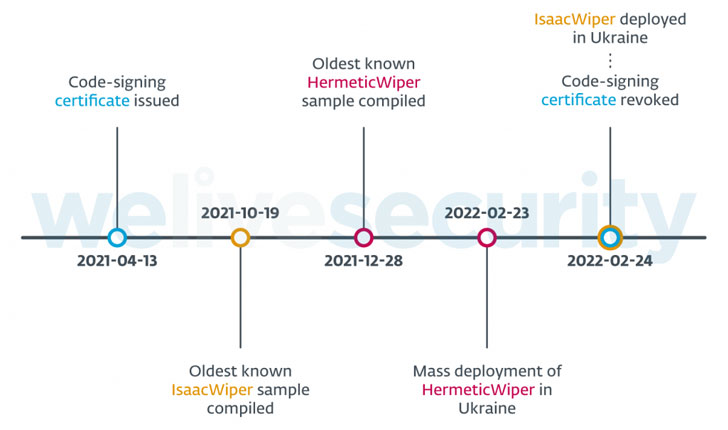
“This is based on several facts: the HermeticWiper PE
compilation timestamps, the oldest being December 28, 2021; the
code-signing certificate issue date of April 13, 2021; and the
deployment of HermeticWiper through the default domain policy in at
least one instance, suggesting the attackers had prior access to
one of that victim’s Active Directory servers,” said Jean-Ian
Boutin, ESET head of threat research.
Also unknown are the initial access vectors used to deploy both
the wipers, although it’s suspected that the attackers leveraged
tools like Impacket[5]
and RemCom, a remote access software, for lateral movement and
malware distribution.
Furthermore, IsaacWiper shares no code-level overlaps with
HermeticWiper and is substantially less sophisticated, even as it
sets out to enumerate all the physical and logical drives before
proceeding to carry out its file wiping operations.
“On February 25, 2022, attackers dropped a new version of
IsaacWiper with debug logs,” the researchers said. “This may
indicate that the attackers were unable to wipe some of the
targeted machines and added log messages to understand what was
happening.”
References
- ^
IsaacWiper
(www.welivesecurity.com) - ^
HermeticWiper
(thehackernews.com) - ^
prior
report (thehackernews.com) - ^
characterized
(securelist.com) - ^
Impacket
(github.com)
Read more https://thehackernews.com/2022/03/second-new-isaacwiper-data-wiper.html