credentials and other financial information has now come back with
new tricks up its sleeve to target government, military, and
manufacturing sectors in the US and Europe, according to new
research.
In an analysis released by Check Point Research today, the
latest wave of Qbot activity appears to have dovetailed with the
return of Emotet[1] — another email-based
malware behind several botnet-driven spam campaigns and ransomware
attacks — last month, with the new sample capable of covertly
gathering all email threads from a victim’s Outlook client and
using them for later malspam campaigns.
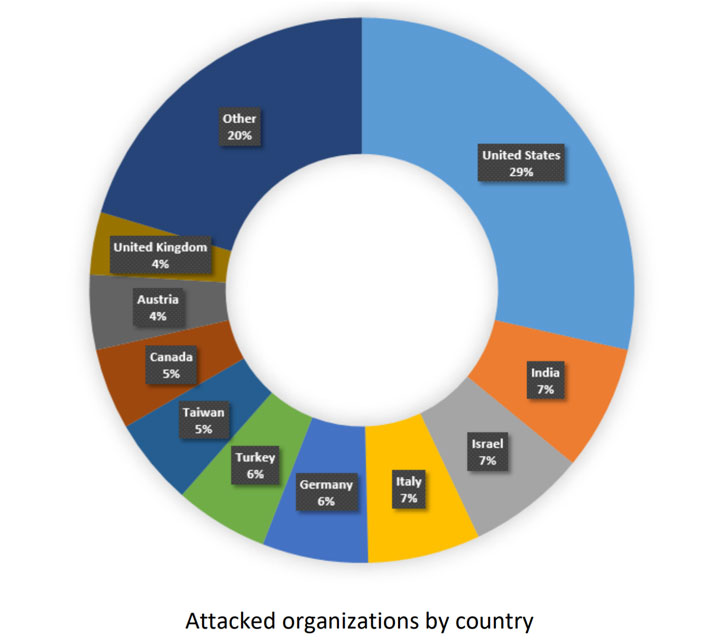
“These days Qbot is much more dangerous than it was previously —
it has an active malspam campaign which infects organizations, and
it manages to use a ‘third-party’ infection infrastructure like
Emotet’s to spread the threat even further,” the cybersecurity firm
said.
Using Hijacked Email Threads as Lures
First documented in 2008, Qbot (aka
QuakBot, QakBot, or Pinkslipbot) has evolved over the years from an
information stealer to a “Swiss Army knife” adept in delivering
other kinds of malware, including Prolock
ransomware, and even remotely connect to a target’s Windows
system to carry out banking transactions from the victim’s IP
address.
victims to websites that use exploits to inject Qbot via a
dropper.
found the malware to be equipped with detection and
research-evasion techniques with the goal of evading forensic
examination. Then last week, Morphisec
unpacked a Qbot sample that came with two new methods designed to
bypass Content Disarm and Reconstruction (CDR) and Endpoint
Detection and Response (EDR) systems.
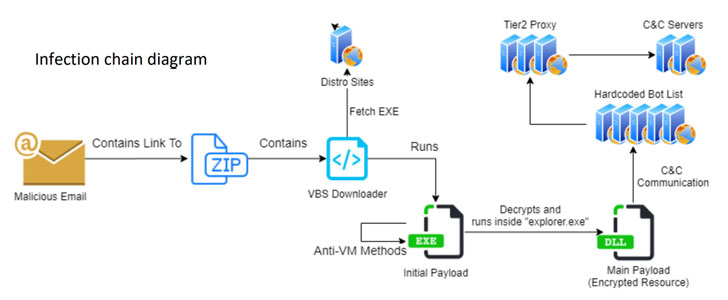
The infection chain detailed by Check Point follows a similar
pattern.
The first step begins with a specially crafted phishing email
containing an attached ZIP file or a link to a ZIP file that
includes a malicious Visual Basic Script (VBS), which then proceeds
to download additional payloads responsible for maintaining a
proper communication channel with an attacker-controlled server and
executing the commands received.
Notably, the phishing emails sent to the targeted organizations,
which take the form of COVID-19 lures, tax payment reminders, and
job recruitments, not only includes the malicious content but is
also inserted with archived email threads between the two parties
to lend an air of credibility.
email collector module that extracts all email threads from the
victim’s Outlook client and uploads them to a hardcoded remote
server.
Aside from packing components for grabbing passwords, browser
cookies, and injecting JavaScript code on banking websites, the
Qbot operators released as many as 15 versions of the malware since
the start of the year, with the last known version released on
August 7.
What’s more, Qbot comes with an hVNC Plugin that makes it
possible to control the victim machine through a remote VNC
connection.
“An external operator can perform bank transactions without the
user’s knowledge, even while he is logged into his computer,” Check
Point noted. “The module shares a high percentage of code with
similar modules like TrickBot’s hVNC.”
From an Infected Machine to a Control Server
That’s not all. Qbot is also equipped with a separate mechanism to
recruit the compromised machines into a botnet by making use of a
proxy module
that allows the infected machine to be used as a control server.
With Qbot hijacking legitimate email threads to spread the
malware, it’s essential that users monitor their emails for
phishing attacks, even in cases they appear to come from a trusted
source.
“Our research shows how even older forms of malware can be
updated with new features to make them a dangerous and persistent
threat,” Check Point Research’s Yaniv Balmas said. “The threat
actors behind Qbot are investing heavily in its development to
enable data theft on a massive scale from organizations and
individuals.”
“We have seen active malspam campaigns distributing Qbot
directly, as well as the use of third-party infection
infrastructures like Emotet’s to spread the threat even further,”
Balmas added.
References
Read more http://feedproxy.google.com/~r/TheHackersNews/~3/DWYrTPcCdQU/qakbot-banking-trojan.html