updated version of its Outlook app for Android that patches a
severe remote code
execution vulnerability[1]
(CVE-2019-1105) that impacted over 100 million users.
However, at that time, very few details of the flaw were
available in the advisory, which just revealed that the earlier
versions of the email app contained a cross-site scripting (XSS)
flaw that could allow attackers to run scripts in the context of
the current user just by sending a specially crafted email to the
victims.
Now, Bryan Appleby from
F5 Networks, one of the security researchers who reported this
issue independently to Microsoft, released more details and
proof-of-concept for the Outlook vulnerability that he reported to
the tech giant almost six months ago.
[2]
In a blog
post[3] published Friday,
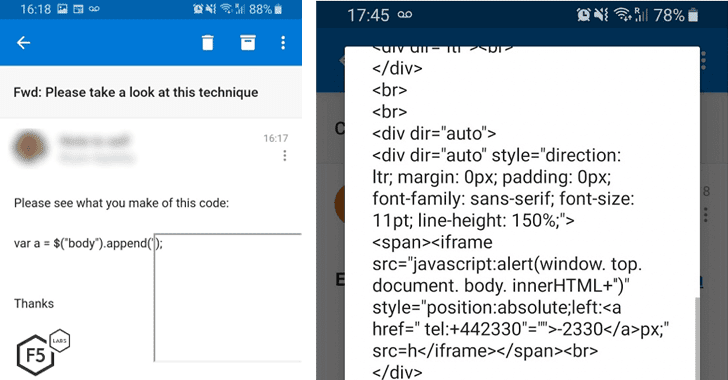
Appleby revealed that while exchanging some JavaScript code with
his friends over an email, he accidentally discovered a cross-site
scripting (XSS) issue that could allow an attacker to embed an
iframe into the email.
In other words, the vulnerability resided in the way email
server parses HTML entities in the email messages.
Though JavaScript running inside an iframe can only access the
content within it, Appleby found that executing JavaScript code
inside the injected iframe can allow the attacker to read
app-related content in the context of logged-in Outlook user,
including their cookies, tokens and even some contents of their
email inbox.
The vulnerability, Appleby said, allowed him to “steal data from
the app—I could use it to read and extract the HTML.”
“This kind of vulnerability could be exploited by an attacker
sending an email with JavaScript in it. The server escapes that
JavaScript and does not see it because it’s within an iframe. When
delivered, the mail client automatically undoes the escaping, and
the JavaScript runs on the client device. Bingo – remote code
execution,” Appleby explains.
“This code can do whatever the attacker desires, up to and
including stealing information and/or sending data back out. An
attacker can send you an email and just by you reading it, they
could steal the contents of your inbox. Weaponized, this can turn
into a very nasty piece of malware.”
December 2018, and the company confirmed the vulnerability on 26
March 2019 when he shared a universal PoC with the tech giant.
Microsoft patched the vulnerability and released a fix just 2
days ago—that’s almost 6 months after the initial
vulnerability disclosure. The company says it is currently not
aware of any attacks in the wild related to this issue.
Once again, if your Android device is not yet updated
automatically, you are advised to update your Outlook app from
Google Play Store manually.
References
- ^
remote code execution vulnerability
(thehackernews.com) - ^
Bryan Appleby
(twitter.com) - ^
blog post
(www.f5.com)
Read more http://feedproxy.google.com/~r/TheHackersNews/~3/_YccFiboFKE/microsoft-outlook-vulnerability.html