
earlier this year with massive malvertising campaigns has now been
caught running a new campaign exploiting two browser
vulnerabilities to show intrusive pop-up ads and forcefully
redirect users to malicious websites.
To be noted, hackers haven’t found any way to run ads for free;
instead, the modus operandi of eGobbler attackers involves high
budgets to display billions of ad impressions on high profile
websites through legit ad networks.
But rather than relying on visitors’ willful interaction with
advertisements online, eGobbler uses browser (Chrome and Safari)
exploits to achieve maximum click rate and successfully hijack as
many users’ sessions as possible.
In its previous malvertising campaign, eGobbler group was
exploiting a then-zero-day vulnerability (CVE-2019-5840) in Chrome
for iOS back in April,
which allowed them to successfully bypass browser’s built-in pop-up
blocker on iOS devices and hijack 500 million mobile user sessions
in just a week to show pop-up ads.
 |
| Malicious sample pop-up ad showing how attackers social engineer victims |
Though Google already patched the
vulnerability with the release of Chrome 75 in June, eGobbler is
still using the flaw to target those who haven’t yet updated their
Chrome browser.
eGobbler Exploits WebKit Flaw to Redirect Users to Malicious
Sites
However, according to the latest report published by security firm
Confiant, the eGobbler threat actors recently discovered and
started exploiting a new vulnerability in
WebKit, the browser engine used by Apple Safari browser for
both iOS and macOS, Chrome for iOS and also by earlier versions of
Chrome for desktop.
The new WebKit exploit is more interesting because it doesn’t
require users to click anywhere on legit news, blog or informative
websites they visit, neither it spawns any pop-up ad.
Instead, the display ads sponsored by eGobbler leverage the
WebKit exploit to forcefully redirect visitors to websites hosting
fraudulent schemes or malware as soon as they press the “key down”
or “page down” button on their keyboards while reading the content
on the website.
JavaScript function, called the onkeydown event that occurs each
time a user presses a key on the keyboard, that allows ads
displayed within iframes to break out of security sandbox
protections.
“This time around, however, the iOS Chrome pop-up was not spawning
as before, but we were, in fact, experiencing redirections on
WebKit browsers upon the ‘onkeydown’ event,” the researchers said
in their latest
report[4].
“The nature of the bug is that a cross-origin nested iframe is able
to ‘autofocus’ which bypasses the
‘allow-top-navigation-by-user-activation’ sandbox directive on the
parent frame.”
“With the inner frame automatically focused, the keydown event
becomes a user-activated navigation event, which renders the ad
sandboxing entirely useless as a measure for forced redirect
mitigation.”
browsing ability to use its WebKit framework, including for Google
Chrome for iOS, mobile users are still less likely to be impacted
by the redirection flaw as the ‘onkeydown’ event doesn’t work on
the mobile OS.
services, also includes code to trigger redirections when visitors
of a targeted web application try to input something in a text area
or search forms, likely “to maximize the chances of hijacking these
keypresses.”
As researchers believe, “this exploit was key in magnifying the
impact of this attack.”
Between August 1 and September 23, the threat actors have been seen
serving their malicious code to a staggering volume of ads, which
the researchers estimate to be up to 1.16 billion impressions.
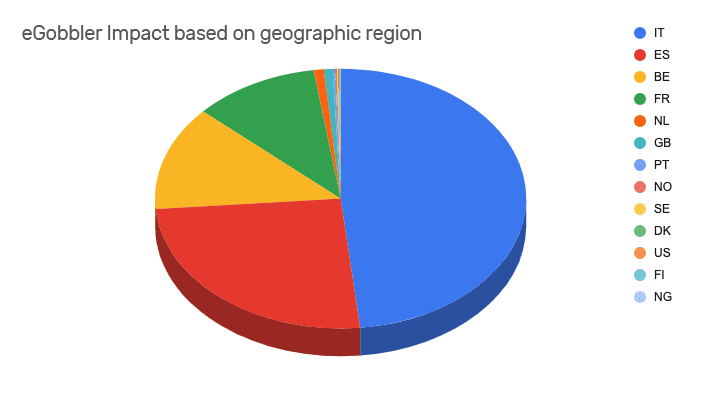
While the previous eGobbler malvertising campaign primarily
targeted iOS users in the United States, the latest attack targeted
users in Europe countries, with a majority being from Italy.
Confiant privately reported the WebKit vulnerability to both the
Google and Apple security teams. Apple fixed the flaw in WebKit
with the release of iOS 13 on September 19 and in Safari browser
13.0.1 on September 24, while Google has yet to
address[5] it in Chrome.
References
- ^
back in April
(blog.confiant.com) - ^
patched
(bugs.chromium.org) - ^
vulnerability in WebKit
(trac.webkit.org) - ^
latest report
(blog.confiant.com) - ^
yet to address
(bugs.chromium.org)
Read more http://feedproxy.google.com/~r/TheHackersNews/~3/OPQ_RIkaUhA/malvertising-webkit-hacking.html