Cybersecurity researchers on Wednesday disclosed a previously
undocumented backdoor likely designed and developed by the Nobelium
advanced persistent threat (APT) behind last year’s SolarWinds supply chain attack[1], joining the threat
actor’s ever-expanding arsenal of hacking tools.
Moscow-headquartered firm Kaspersky codenamed the malware
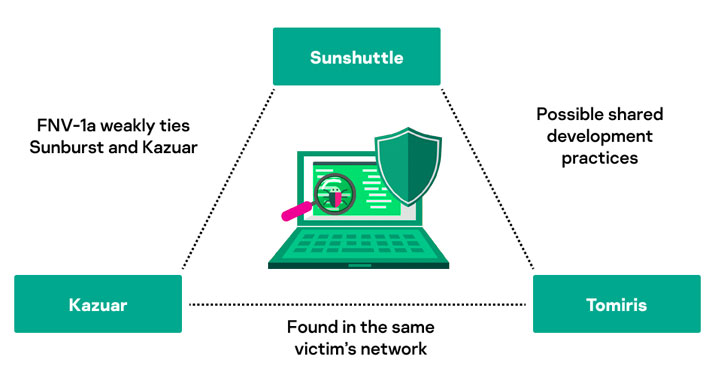
“Tomiris,” calling out its similarities to another
second-stage malware used during the campaign, SUNSHUTTLE (aka
GoldMax), targeting the IT management software provider’s Orion
platform. Nobelium is also known by the monikers UNC2452,
SolarStorm, StellarParticle, Dark Halo, and Iron Ritual.
“While supply-chain attacks were already a documented attack
vector leveraged by a number of APT actors, this specific campaign
stood out due to the extreme carefulness of the attackers and the
high-profile nature of their victims,” Kaspersky researchers
said[2]. “Evidence gathered so
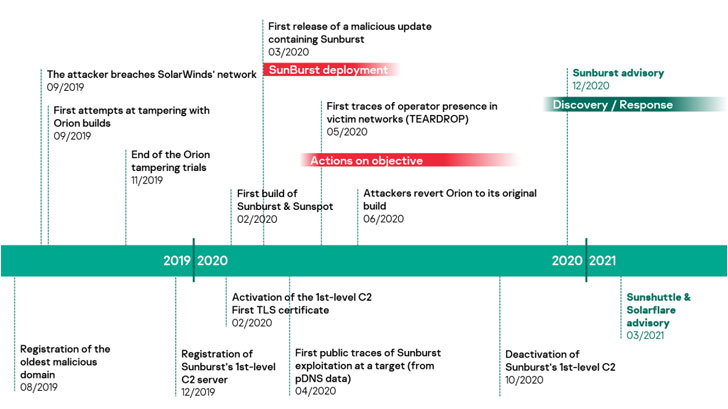
far indicates that Dark Halo spent six months inside Orion IT’s
networks to perfect their attack and make sure that their tampering
of the build chain wouldn’t cause any adverse effects.”
Microsoft, which detailed SUNSHUTTLE[3]
in March 2021, described the strain as a Golang-based malware that
acts as a command-and-control backdoor, establishing a secure
connection with an attacker-controlled server to fetch and execute
arbitrary commands on the compromised machine as well as exfiltrate
files from the system to the server.
The new Tomiris backdoor, found by Kaspersky in June this year
from samples dating back to February, is also written in Go and
deployed via a successful DNS hijacking attack during which targets
attempting to access the login page of a corporate email service
were redirected to a fraudulent domain set up with a lookalike
interface designed to trick the visitors into downloading the
malware under the guise of a security update.
The attacks are believed to have been mounted against several
government organizations in an unnamed CIS[4]
member state.
“The main purpose of the backdoor was to establish a foothold in
the attacked system and to download other malicious components,”
the researchers said, in addition to finding a number of
similarities ranging from the encryption scheme to the same
spelling mistakes that collectively hint at the “possibility of
common authorship or shared development practices.”
This is not the first time overlaps have been discovered between
different tools put to use by the threat actor. Earlier this year,
Kaspersky’s analysis[5]
of Sunburst revealed a number of shared features between the
malware and Kazuar, a .NET-based backdoor attributed to the Turla
group. Interestingly, the cybersecurity company said it detected
Tomiris in networks where other machines were infected with Kazuar,
adding weight to prospects that the three malware families could be
linked to each other.
Having said that, the researchers pointed out it could also be a
case of a false flag attack, wherein threat actors deliberately
reproduce the tactics and techniques adopted by a known adversary
in an attempt to mislead attribution.
The revelation comes days after Microsoft took the wraps of a
passive and highly targeted implant dubbed FoggyWeb[6]
that was employed by the Nobelium group to deliver additional
payloads and steal sensitive information from Active Directory
Federation Services (AD FS) servers.