
Apple‘s then-newly introduced macOS privacy feature has once
again found a new way to bypass security warnings by performing
‘Synthetic Clicks’ on behalf of users without requiring their
interaction.
Last June, Apple introduced a core security feature in MacOS
that made it mandatory for all applications to take permission
(“allow” or “deny”) from users before accessing sensitive data or
components on the system, including the device camera or
microphone, location data, messages, and browsing history.
For those unaware, ‘Synthetic Clicks’ are programmatic and
invisible mouse clicks that are generated by a software program
rather than a human.
MacOS itself has built-in functionality for synthetic clicks,
but as an accessibility feature for disabled people to interact
with the system interface in non-traditional ways.
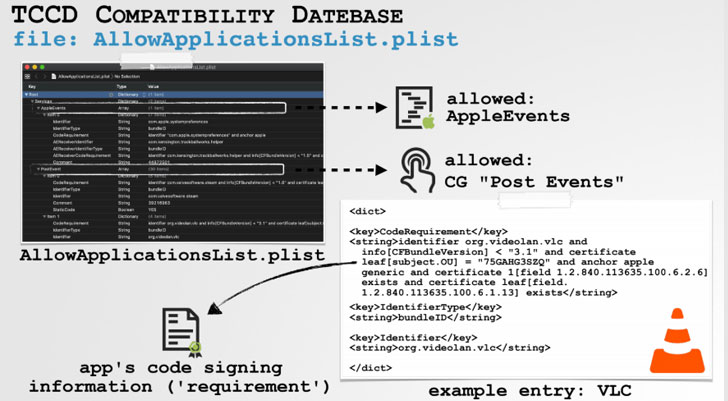
preventing malicious apps from abusing these programmatic clicks.
However, security researcher Patrick Wardle, at that time, found
a critical flaw in
macOS that could have allowed malicious applications installed
on a targeted system to virtually “click” security prompt buttons
without any user interaction or actual consent.
[2]
Though Apple patched that issue after few weeks from the public
disclosure, Wardle has once again publicly
demonstrated a new way around that could allow apps to perform
‘Synthetic Clicks‘ to access users’ private data without
their explicit permission.
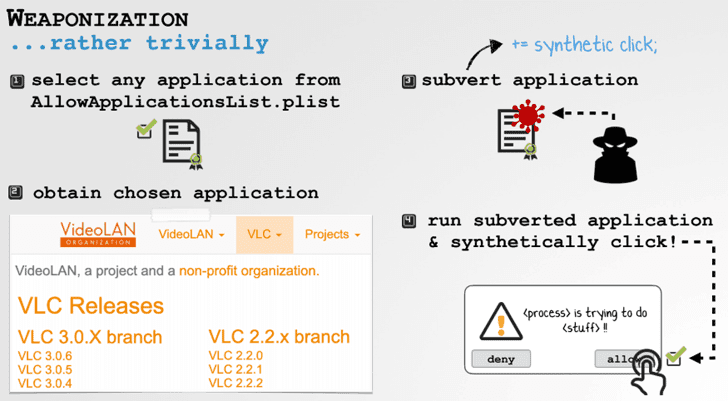
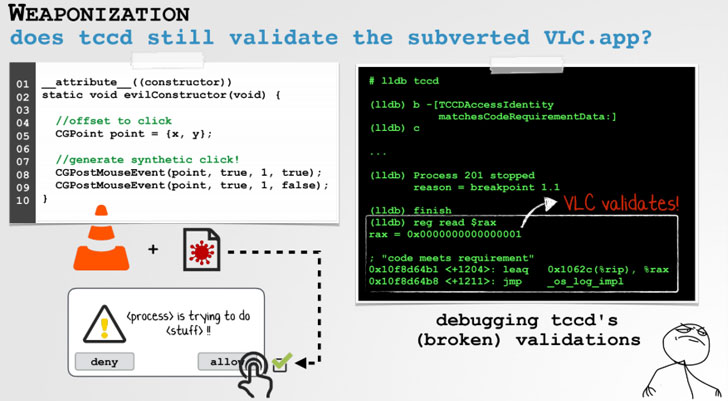
flaw in the way macOS checks the integrity of whitelisted apps. The
operating system checks the existence of an app’s digital
certificate but fails to validate if the app has been tampered
with.
“System attempts to verify/validate at these allowed whitelisted
apps haven’t been subverted—but their check is flawed, meaning, an
attacker can subvert any of these, and add/inject code to perform
arbitrary synthetic clicks—for example to interact with
security/privacy alerts in Mojave to access user’s location, the
microphone, webcam, photos, SMS/call records,” Wardle told The
Hacker News.
Moreover, “those [whitelisted] apps don’t have to be present on the
system. The attacker could bring one of the whitelisted apps to the
system (perhaps pre-subverted) and run it in the background, to
generate clicks.”
Sea conference in Monte Carlo, Wardle abused VLC Player, one of the
Apple’s approved apps, to include his malware as an unsigned plugin
and perform synthetic clicks on a consent prompt programmatically
without actually requiring any user’s interaction.
Wardle refers to the new synthetic click vulnerability as a “2nd
stage attack,” meaning an attacker would need to have remote access
to a victim’s macOS computer already or have installed a malicious
application.
Wardle reported his findings to Apple last week and the company
confirmed receiving his report, but did not clear when it is
planning to patch the issue.
References
- ^
last year bypassed Apple
(thehackernews.com) - ^
critical flaw in macOS
(thehackernews.com) - ^
publicly demonstrated
(twitter.com)
Read more http://feedproxy.google.com/~r/TheHackersNews/~3/KCc2lB51ZE8/macOS-synthetic-click.html