
Google on Monday introduced a new bug bounty program for its
open source projects, offering payouts anywhere from $100 to
$31,337 (a reference to eleet or
leet[1]) to secure the ecosystem
from supply chain attacks[2].
Called the Open Source Software Vulnerability Rewards Program
(OSS VRP), the offering is one of the first open source-specific
vulnerability programs.
With the tech giant the maintainer of major projects such as
Angular, Bazel, Golang, Protocol Buffers, and Fuchsia, the program
aims to reward vulnerability discoveries that could otherwise have
a significant impact on the larger open source landscape.
Other projects managed by Google and hosted on public
repositories such as GitHub as well as the third-party dependencies
that are included in those projects are also eligible.
Submissions[3]
from bug hunters are expected to meet the following criteria –
- Vulnerabilities that lead to supply chain compromise
- Design issues that cause product vulnerabilities
- Other security issues such as sensitive or leaked credentials,
weak passwords, or insecure installations
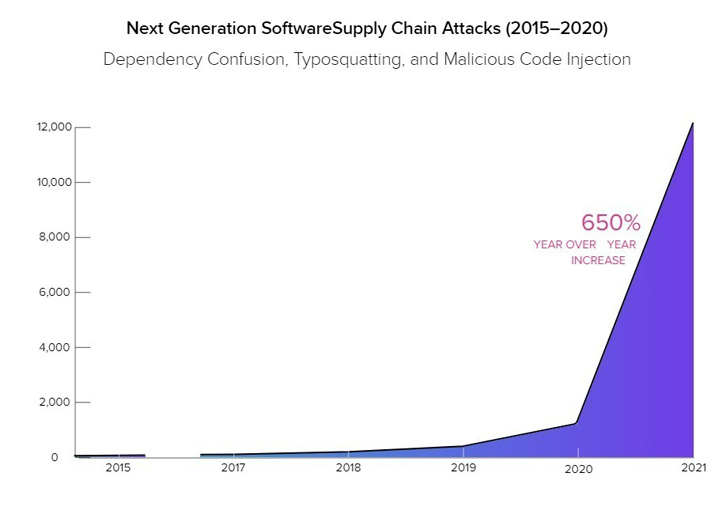
Beefing up open source components, especially third-party
libraries that act as the building block of many a software, has
emerged a top priority in the wake of steady escalation in supply
chain attacks targeting Maven, NPM, PyPI, and RubyGems.
 |
| Image credit: Sonatype |
The Log4Shell vulnerability[4]
in the Log4j Java logging library that came to light in December
2021 is a prime example, causing widespread havoc and becoming a
clarion call for improving the state of the software supply
chain.
“Last year saw a 650% year-over-year increase[5] in attacks targeting the
open source supply chain, including headliner incidents like
Codecov[6]
and the Log4j vulnerability that showed the destructive potential
of a single open source vulnerability,” Google’s Francis Perron and
Krzysztof Kotowicz said[7].
The move follows a similar rewards program Google instituted last November[8] for uncovering privilege
escalation and Kubernetes escape exploits in the Linux Kernel. It
has since upped the maximum amount[9] from $50,337 to $91,337
until the end of 2022.
Earlier this May, the internet behemoth announced the creation
of a new “Open Source Maintenance Crew[10]” to focus on bolstering
the security of critical open source projects.
References
- ^
eleet or
leet (en.wikipedia.org) - ^
supply
chain attacks (thehackernews.com) - ^
Submissions
(bughunters.google.com) - ^
Log4Shell vulnerability
(thehackernews.com) - ^
650%
year-over-year increase (www.sonatype.com) - ^
Codecov
(thehackernews.com) - ^
said
(security.googleblog.com) - ^
instituted last November
(thehackernews.com) - ^
upped
the maximum amount
(security.googleblog.com) - ^
Open
Source Maintenance Crew (thehackernews.com)
Read more https://thehackernews.com/2022/08/google-launches-new-open-source-bug.html