
browser automatically fix certain TLS errors, often triggered when
antivirus software installed on a system tries to intercept secure
HTTPS connections.
Most Antivirus software offers web security feature that
intercepts encrypted HTTPS connections to monitor the content for
malicious web pages before it reaches the web browser.
To achieve this, security software replaces websites’ TLS
certificates with their own digital certificates issued by any
trusted Certificate Authorities (CAs).
Since Mozilla only trusts those CAs that are listed in its own
root store, the antivirus products relying on other trusted CAs
provided by the operating system (OS) are not allowed to intercept
HTTPS connections on Firefox.
In recent months, this limitation continually crashed HTTPS pages
for many Firefox users showing them SEC_ERROR_UNKNOWN_ISSUER,
MOZILLA_PKIX_ERROR_MITM_DETECTED or ERROR_SELF_SIGNED_CERT error
codes when their antivirus attempts to intercept an HTTPS-enabled
page by adding its root certificate to Firefox store.
To let users easily fix this issue, starting with Firefox 68,
the browser will now automatically enable the “enterprise roots”
preference and retry the connection whenever it detects a
“Man-in-the-Middle” TLS error.
Enabling the “security.enterprise_roots.enabled” setting
configures Firefox to trust certificates in the operating system
certificate store by importing “any root CAs that have been added
to the OS by the user, an administrator, or a program that has been
installed on the computer.”
According to the company, this option is available on Windows
and MacOS.
The company has also recommended antivirus vendors to enable the
“enterprise roots” preference instead of adding their own root CA
to the Firefox root store.
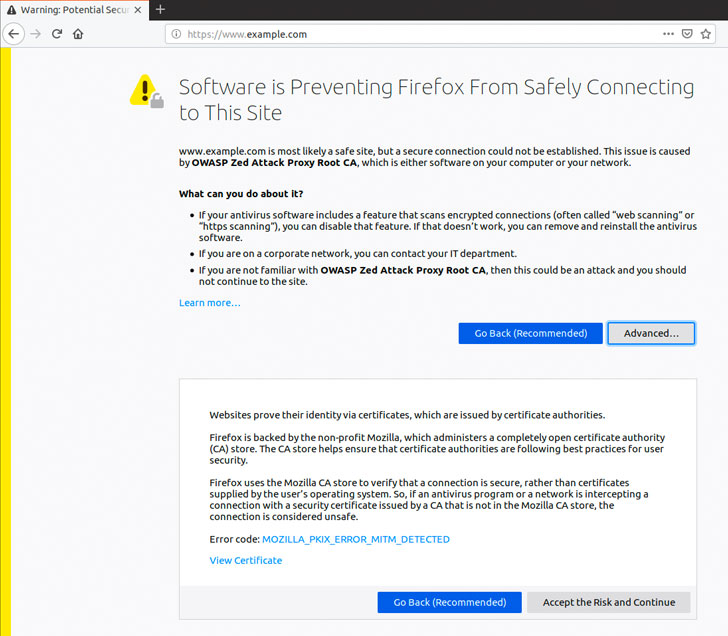
“enterprise roots” preference setting will come enabled by default.
“Because extended support releases are often used in enterprise
settings where there is a need for Firefox to recognize the
organization’s own internal CA, this change will streamline the
process of deploying Firefox for administrators,” Mozilla explains[1].
trusting certificates that haven’t been audited and gone through
the rigorous Mozilla process, the company says “any user or program
that has the ability to add a CA to the OS almost certainly also
has the ability to add that same CA directly to the Firefox root
store.”
“Also, because we only import CAs that are not included with the
OS, Mozilla maintains our ability to set and enforce the highest
standards in the industry on publicly-trusted CAs that Firefox
supports by default.”
“In short, the changes we’re making meet the goal of making Firefox
easier to use without sacrificing security.”
be released on 9th July, the sensitive device features like the
camera and microphone will require an HTTPS
connection[2] to work with the
browser.
References
- ^
explains
(blog.mozilla.org) - ^
require an HTTPS connection
(blog.mozilla.org)
Read more http://feedproxy.google.com/~r/TheHackersNews/~3/zPfr95aOvyg/firefox-https-security.html