
The operators of the Mozi IoT botnet have been taken into
custody by Chinese law enforcement authorities, nearly two years
after the malware emerged on the threat landscape in September
2019.
News of the arrest, which originally happened[1]
in June, was disclosed[2]
by researchers from Netlab, the network research division of
Chinese internet security company Qihoo 360, earlier this Monday,
detailing its involvement in the operation. The
“Mozi uses a P2P [peer-to-peer] network structure, and one of
the ‘advantages’ of a P2P network is that it is robust, so even if
some of the nodes go down, the whole network will carry on, and the
remaining nodes will still infect other vulnerable devices, that is
why we can still see Mozi spreading,” said Netlab, which spotted
the botnet for the first time in late 2019.
The development also comes less than two weeks after Microsoft
Security Threat Intelligence Center revealed[3]
the botnet’s new capabilities that enable it to interfere with the
web traffic of infected systems via techniques such as DNS spoofing
and HTTP session hijacking with the goal of redirecting users to
malicious domains.
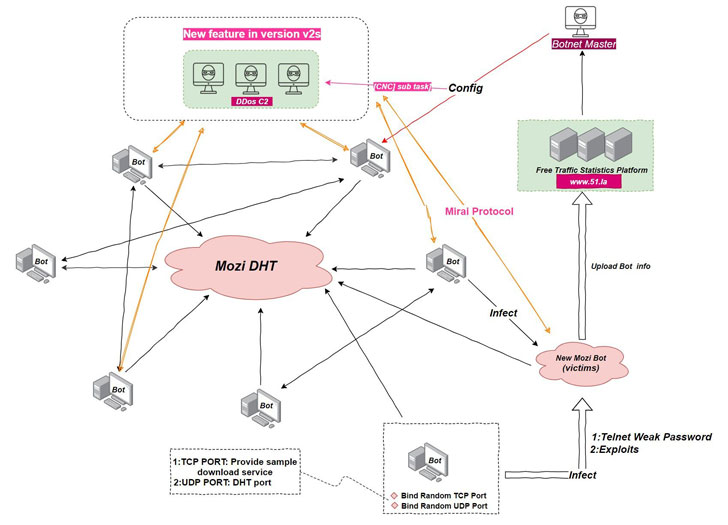
Mozi, which evolved from the source code of several known
malware families such as Gafgyt, Mirai, and IoT Reaper, is said to
have amassed more than 15,800 command-and-control nodes, according
to a report[4]
from Lumen’s Black Lotus Labs released in April 2020, a number that
has since ballooned to 1.5 million[5], with China and India
accounting for the most infections.
Exploiting the use of weak and default remote access passwords
as well as through unpatched vulnerabilities, the botnet propagates
by infecting routers and digital video recorders to co-opt the
devices into an IoT botnet, which could be abused for launching
distributed denial-of-service (DDoS) attacks, data exfiltration,
and payload execution.
Now according to Netlab, the Mozi authors also packed in
additional upgrades, which includes a mining trojan that spreads in
a worm-like fashion through weak FTP and SSH passwords, expanding
on the botnet’s features by following a plug-in like approach to
designing custom tag commands for different functional nodes. “This
convenience is one of the reasons for the rapid expansion of the
Mozi botnet,” the researchers said.
What’s more, Mozi’s reliance on a BitTorrent-like Distributed
Hash Table (DHT) to communicate with other nodes in the botnet
instead of a centralized command-and-control server allows it to
function unimpeded, making it difficult to remotely activate a kill
switch and render the malware ineffective on compromised hosts.
“The Mozi botnet samples have stopped updating for quite some
time, but this does not mean that the threat posed by Mozi has
ended,” the researchers cautioned. “Since the parts of the network
that are already spread across the Internet have the ability to
continue to be infected, new devices are infected every day.”
References
Read more http://feedproxy.google.com/~r/TheHackersNews/~3/Q2u5nz4MrzI/chinese-authorities-arrest-hackers.html