
on smartphones of foreigners at border crossings in the Xinjiang
region who are entering from neighboring Kyrgyzstan, an
international investigation revealed.
Xinjiang (XUAR) is an autonomous territory and home to many
Muslim ethnic minority groups where China is known to be conducting
massive surveillance operations, especially on the activities of
Uighurs, a Muslim Turkic minority group of about 8 million
people.
The Chinese government has blamed the Muslim Turkic minority
group for Islamic extremism and deadly attacks on Chinese
targets.
According to a joint investigation by New York Times,
the Guardian, Süddeutsche Zeitung and more, the surveillance app
has been designed to instantly extract emails, texts, calendar
entries, call records, contacts and insecurely uploads them to a
local server set-up at the check-point only.
This suggests that the spyware app has not been designed to
continuously and remotely track people while in China. In fact, in
the majority of cases, the report says the surveillance app is
uninstalled before the phone is returned to its owner.
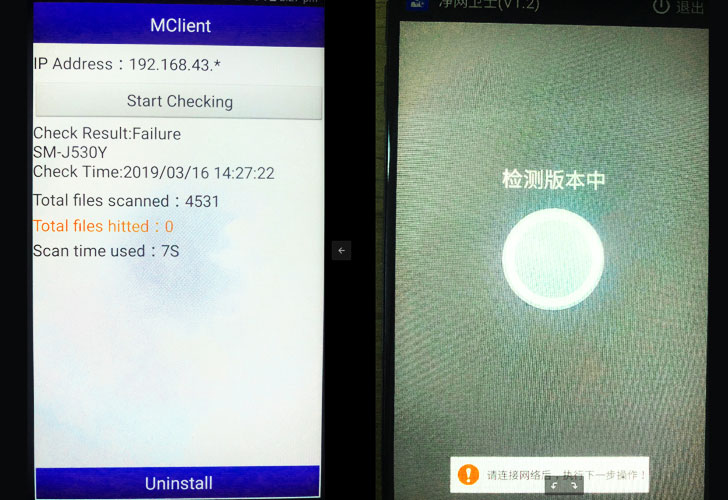
The spyware, called Feng Cai (蜂采) or BXAQ[2], also scans infected
Android devices for over 73,000 pre-defined files related to
Islamic extremist groups, including ISIS recruitment fliers,
bomb-making instructions, and images of executions.
of an Arabic dictionary and information on the Dalai Lama, and for
some bizarre reason, the list also includes a song from a Japanese
grindcore band called Unholy Grace.
The app can directly be installed on Android phones, but for
tourists, journalists, and other foreigners, using Apple devices,
the border guards reportedly connect their phones to a
hardware-based device that is believed to install similar
spyware.
According to researchers at German cybersecurity firm Cure53, who
analyzed [PDF] a sample of the surveillance app,
the names that appear in Feng Cai app’s source code suggest that
the app was developed by a unit of FiberHome, a Chinese telecom
manufacturer that is partly owned by the government.
“The app is very simple in terms of its user interface, with just
three available functions: Scan, Upload, and Uninstall,” the
researchers said.
travelers is stored on the Chinese server, or how the government
uses it.
“The Chinese government, both in law and practice, often conflates
peaceful religious activities with terrorism,” Maya Wang, a Chinese
researcher at Human Rights Watch, told NY Times. “You can see in
Xinjiang, privacy is a gateway right: Once you lose your right to
privacy, you’re going to be afraid of practicing your religion,
speaking what’s on your mind or even thinking your thoughts.”
using spyware to keep tabs on people in the Xinjiang region, as
this kind of intensive surveillance is very common in that region.
However, it’s the first time when tourists are believed to have
been the primary target.
In 2017, Chinese authorities had forced Xinjiang
residents[4] as well into installing
a similar spyware app, called Jingwang, on their mobile
devices that was intended to prevent them from accessing terrorist
information.
References
- ^
New York Times
(www.nytimes.com) - ^
BXAQ
(github.com) - ^
PDF (cure53.de) - ^
forced Xinjiang residents
(www.hongkongfp.com)
Read more http://feedproxy.google.com/~r/TheHackersNews/~3/Nnq7qPjhSZc/xinjiang-fengcai-spyware.html