motherboards can remotely be compromised by virtually plugging in
malicious USB devices, cybersecurity researchers at firmware
security company Eclypsium told The Hacker News.
Yes, that’s correct. You can launch all types of USB attacks
against vulnerable Supermicro servers without actually physically
accessing them or waiting for your victim to pick up an unknown,
untrusted USB drive and plug it into their computer.
Collectively dubbed “USBAnywhere,” the attack leverages
several newly discovered vulnerabilities in the firmware of BMC
controllers that could let an unauthorized, remote attacker connect
to a Supermicro server and virtually mount malicious USB
device.
Comes embedded with a majority of server chipsets, a baseboard
management controller (BMC) is a hardware chip at the core of
Intelligent Platform Management Interface (IPMI) utilities that
allows sysadmins to remotely control and monitor a server without
having to access the operating system or applications running on
it.
In other words, BMC is an out-of-band management system that allows
admins to remotely reboot a device, analyze logs, install an
operating system, and update the firmware—making it one of the most
privileged components in enterprise technology today.
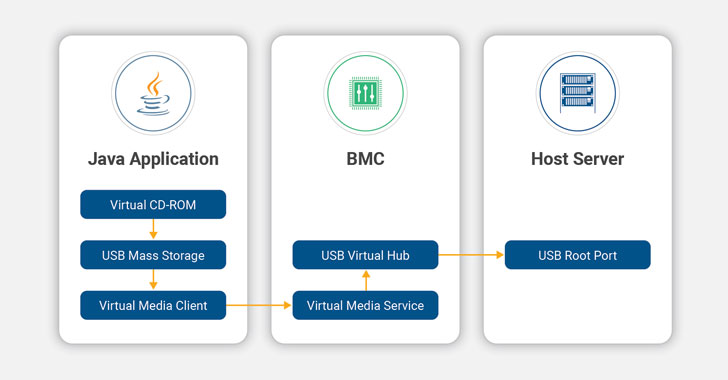
One such BMC ability includes mounting virtual media to connect
a disk image as a virtual USB CD-ROM or floppy drive with a remote
server.
According to a report published today by Eclypsium and shared
with The Hacker News prior to the publication, BMCs on Supermicro
X9, X10, and X11 platforms use an insecure implementation to
authenticate the client and transport USB packets between client
and server.
remote attacker to bypass authentication process over virtual media
service listening on TCP port 623 or intercept traffic to recover
weakly encrypted BMC credentials or totally unencrypted
credentials.
- Plaintext Authentication
- Unencrypted Network Traffic
- Weak Encryption
- Authentication Bypass (X10 and X11 platforms only)
“When accessed remotely, the virtual media service allows plaintext
authentication, sends most traffic unencrypted, uses a weak
encryption algorithm for the rest, and is susceptible to an
authentication bypass,” the researchers
explain.
“These issues allow an attacker to easily gain access to a
server, either by capturing a legitimate user’s authentication
packet, using default credentials, and in some cases, without any
credentials at all.”
Once connected, the compromised virtual media service lets
attackers interact with the host system as a raw USB device,
allowing them to perform everything that can be done with physical
access to a USB port, including:
- data exfiltration,
- implant malware,
- booting from untrusted OS images,
- direct manipulation of the system via a virtual keyboard and
mouse, and - disable the device entirely.
According to the researchers, a scan of TCP port 623 across the
Internet revealed more than 47,000 BMCs from over 90 different
countries with the affected BMC firmware virtual media service
publicly accessible.
Besides exploiting BMCs where virtual media services are
directly exposed on the Internet, these flaws can also be exploited
by an attacker with access to a closed corporate network or
man-in-the-middle attackers within the client-side networks.
The researchers reported their findings to Supermicro in June
and July this year. The company acknowledged the issues in August
and publicly released a firmware update for their X9, X10 and X11
platforms before September 3rd.
Organizations are therefore encouraged to update their BMC
firmware as soon as possible. Moreover, it is important to make
sure that BMCs should never be directly exposed to the Internet, as
direct exposure to the Internet greatly increases the likelihood of
such attacks.
References
- ^
researchers explain
(eclypsium.com)
Read more http://feedproxy.google.com/~r/TheHackersNews/~3/FJQZomCHdYI/hacking-bmc-server.html