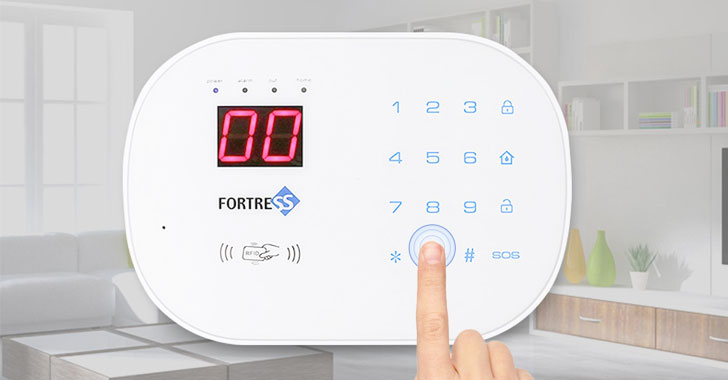
New vulnerabilities have been discovered in Fortress S03 Wi-Fi
Home Security System that could be potentially abused by a
malicious party to gain unauthorized access with an aim to alter
system behavior, including disarming the devices without the
victim’s knowledge.
The two unpatched issues, tracked under the identifiers
CVE-2021-39276 (CVSS score: 5.3) and CVE-2021-39277 (CVSS score:
5.7), were discovered and reported by cybersecurity firm Rapid7 in
May 2021 with a 60-day deadline to fix the weaknesses.
The Fortress S03 Wi-Fi Home Security System is a do-it-yourself
(DIY) alarm system that enables users to secure their homes and
small businesses from burglars, fires, gas leaks, and water leaks
by leveraging Wi-Fi and RFID technology for keyless entry. The
company’s security and surveillance systems are used by “thousands
of clients and continued customers,” according[1]
to its website.
Calling the vulnerabilities “trivially easy to exploit,”
Rapid7[2]
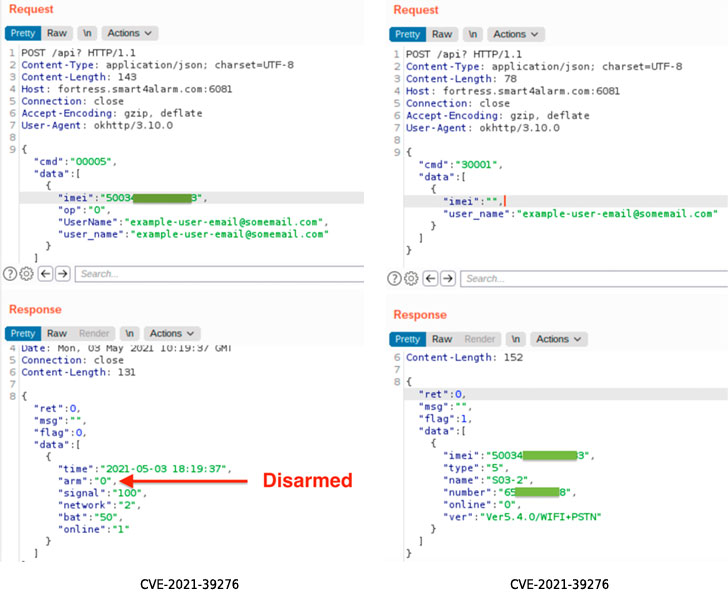
researchers noted CVE-2021-39276 concerns an unauthenticated API
Access that enables an attacker in possession of a victim’s email
address to query the API to leak the device’s International Mobile
Equipment Identity (IMEI) number, which also doubles up as the
serial number. Armed with the device’s IMEI number and the email
address, the adversary can proceed to make a number of unauthorized
changes, such as disabling the alarm system via an unauthenticated
POST request.
CVE-2021-39277, on the other hand, relates to an RF Signal
replay attack[3], wherein a lack of
adequate encryption grants the bad actor the ability to capture the
radio frequency command and control communications over the air
using software-defined radio (SDR), and playback the transmission
to perform specific functions, such as “arm” and “disarm”
operations, on the target device.
“For CVE-2021-39276, an attacker with the knowledge of a
Fortress S03 user’s email address can easily disarm the installed
home alarm without that user’s knowledge,” the researchers said in
a report shared with The Hacker News.
“CVE-2021-39277 presents similar problems, but requires less
prior knowledge of the victim, as the attacker can simply stake out
the property and wait for the victim to use the RF-controlled
devices within radio range. The attacker can then replay the
‘disarm’ command later, without the victim’s knowledge.”
Rapid7 said it notified Fortress Security of the bugs on May 13,
2021, only for the company to close the report 11 days later on May
24. We have reached out to Fortress Security for comment, and we
will update the story if we hear back.
In light of the fact that the issues continue to persist, it’s
recommended that users configure their alarm systems with a unique,
one-time email address to work around the IMEI number exposure.
“For CVE-2021-39277, there seems to be very little a user can do
to mitigate the effects of the RF replay issues absent a firmware
update to enforce cryptographic controls on RF signals. Users
concerned about this exposure should avoid using the key fobs and
other RF devices linked to their home security systems,” the
researchers said.