
meet their own financial objectives. But it’s an entirely different
matter when they are used as “hackers for hire” by competing
private companies to make away with confidential information.
Bitdefender’s Cyber Threat Intelligence Lab discovered yet
another instance of an espionage attack targeting an unnamed
international architectural and video production company that had
all the hallmarks of a carefully orchestrated campaign.
“The cybercriminal group infiltrated the company using a tainted
and specially crafted plugin for Autodesk 3ds Max,” Bitdefender
researchers said in a report
released[1] today.
“The investigation also found that the Command and Control
infrastructure used by the cybercriminal group to test their
malicious payload against the organization’s security solution, is
located in South Korea.”
Although there have been previous instances of APT mercenary
groups such as Dark Basin and
Deceptikons (aka
DeathStalker)
targeting the financial and legal sector, this is the first time a
threat actor has employed the same modus operandi to the
real-estate industry.
[2][3][4]
was found using tainted software installers as a dropper to
introduce a backdoor for document exfiltration.
“This is likely to become the new normal in terms of the
commoditization of APT groups — not just state-sponsored actors,
but by anyone seeking their services for personal gain, across all
industries,” the cybersecurity firm said.
Using a Tainted Autodesk 3ds Max Plugin
In an advisory published
earlier this month, Autodesk warned users about a variant of
“PhysXPluginMfx” MAXScript exploit that can corrupt 3ds Max’s
settings, run malicious code, and propagate to other MAX files on a
Windows system upon loading the infected files into the
software.
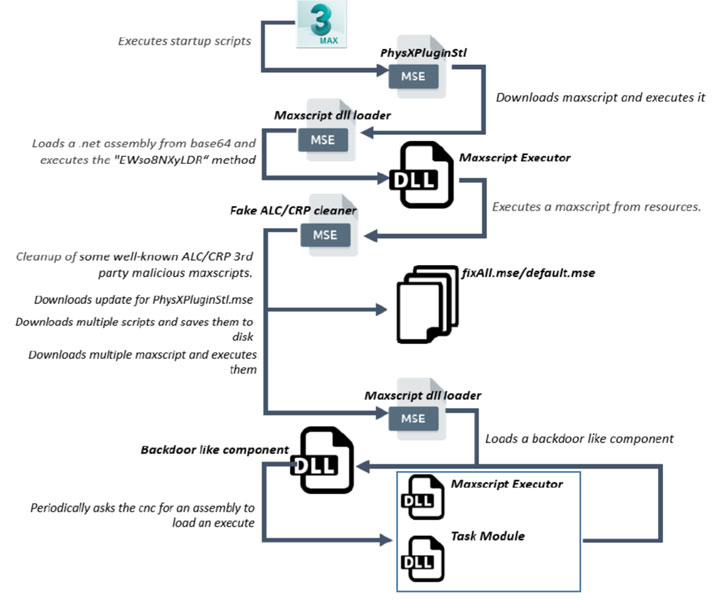
MAXScript Encrypted sample (“PhysXPluginStl.mse”) contained an
embedded DLL file, which subsequently went on to download
additional .NET binaries from the C&C server with the ultimate
goal of stealing important documents.
The binaries, in turn, are responsible for downloading other
malicious MAXScripts capable of collecting information about the
compromised machine and exfiltrating the details to the remote
server, which transmits a final payload that can capture
screenshots and gather passwords from web browsers such as Firefox,
Google Chrome, and Internet Explorer.
Aside from employing a sleep mechanism to lie under the radar
and evade detection, Bitdefender researchers also found that the
malware authors had an entire toolset for spying upon its victims,
including a “HdCrawler” binary, whose job is to enumerate and
upload files with specific extensions (.webp, .jpg, .png, .zip,
.obb, .uasset, etc.) to the server, and an info-stealer with
extensive features.
The information amassed by the stealer ranges from the username,
computer name, the IP addresses of network adapters, Windows
ProductName,
version of the .NET Framework, processors (number of cores, the
speed, and other information), total and free RAM available,
storage details to the names of processes running on the system,
the files set to start automatically following a boot, and the list
of recent files accessed.
Bitdefender’s telemetry data also found other similar malware
samples communicating with the same C&C server, dating back to
just under a month ago, suggesting that the group targets other
victims.
It’s recommended that 3ds Max users download the latest version
of Security Tools for Autodesk 3ds Max 2021-2015SP1 to identify and
remove the PhysXPluginMfx MAXScript malware.
“The sophistication of the attack reveals an APT-style group
that had prior knowledge of the company’s security systems and used
software applications, carefully planning their attack to
infiltrate the company and exfiltrate data undetected,” the
researchers said.
“Industrial espionage is nothing new and, since the real-estate
industry is highly competitive, with contracts valued at billions
of dollars, the stakes are high for winning contracts for luxury
projects and could justify turning to mercenary APT groups for
gaining a negotiation advantage.”
References
- ^
report released
(www.bitdefender.com) - ^
Dark Basin
(citizenlab.ca) - ^
Deceptikons
(securelist.com) - ^
DeathStalker
(securelist.com) - ^
StrongPity
(thehackernews.com) - ^
published
(www.autodesk.com) - ^
ProductName
(docs.microsoft.com)
Read more http://feedproxy.google.com/~r/TheHackersNews/~3/olMMd3bT0ds/autodesk-malware-attack.html