
Cybersecurity researchers on Monday disclosed a new malspam
campaign distributing a fresh variant of a malware loader called
‘Buer’ written in Rust, illustrating how adversaries are constantly
honing their malware toolsets to evade analysis.
Dubbed “RustyBuer,” the malware is distributed via emails
masquerading as shipping notices from DHL Support, and is said to
have affected no fewer than 200 organizations across more than 50
verticals since early April.
“The new Buer variant is written in Rust, an efficient and
easy-to-use programming language that is becoming increasingly
popular,” Proofpoint researchers said[1]
in a report shared with The Hacker News. “Rewriting the malware in
Rust enables the threat actor to better evade existing Buer
detection capabilities.”
First introduced in August of 2019, Buer[2]
is a modular malware-as-a-service offering that’s sold on
underground forums and used as a first-stage downloader to deliver
additional payloads, providing initial compromise of targets’
Windows systems and allowing the attacker to establish a “digital
beachhead” for further malicious activity. A Proofpoint analysis[3]
in December 2019 characterized Buer as a malware coded entirely in
C, using a control panel written in .NET Core.
In September 2020, the operators behind the Ryuk ransomware[4]
were found using the Buer malware dropper as an initial access
vector as part of a spam campaign. Then a phishing attack uncovered
in February 2021 employed[5]
invoice-themed lures to entice users into opening Microsoft Excel
documents that contain malicious macros, which download and execute
the Buer dropper on the infected system.
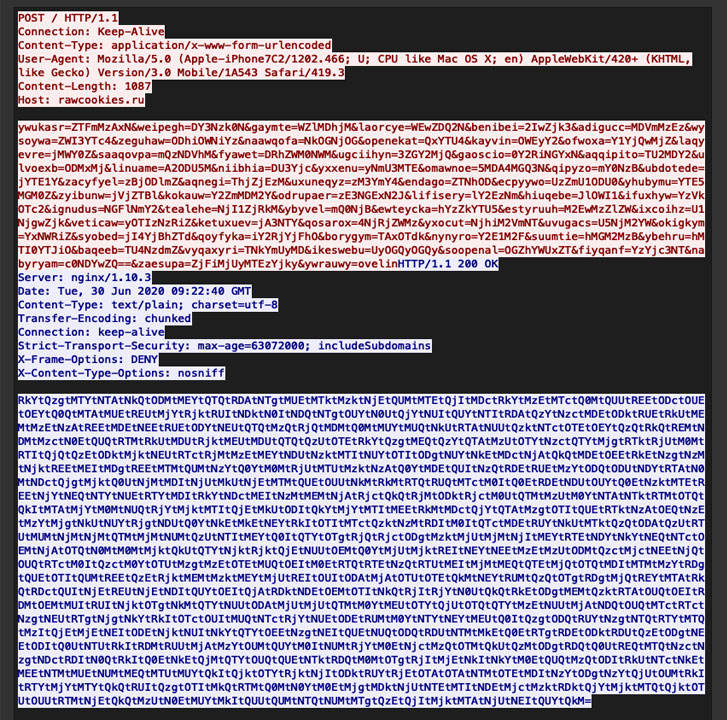 |
| Buer Loader initial POST request |
The new maldoc campaign that delivered the Buer malware loader
follows a similar modus operandi, using DHL-themed phishing emails
to distribute weaponized Word or Excel documents that drop the Rust
variant of Buer loader. The “unusual” departure from the C
programming language means Buer is now capable of circumventing
detections that are based on features of the malware written in
C.
“The rewritten malware, and the use of newer lures attempting to
appear more legitimate, suggest threat actors leveraging RustyBuer
are evolving techniques in multiple ways to both evade detection
and attempt to increase successful click rates,” the researchers
said.
Given the fact that Buer acts as a first-stage loader for other
kinds of malware, including Cobalt Strike and ransomware strains,
Proofpoint researchers estimate that cyber attackers may be using
the loader to gain a foothold into target networks and sell the
access to other actors in what’s an “access-as-a-service”
scheme.
RustyBuer is the latest in a series of efforts aimed at adding
an extra layer of opacity, as cybercriminals are paying increased
attention to new programming languages in hopes that doing so will
enable the attack code to slip past security defenses. Earlier this
year, a malware called “NimzaLoader[6]” was identified as
written in Nim programming language, followed by a macOS adware
named “Convuster[7]” that was based on
Rust.
“When paired with the attempts by threat actors leveraging
RustyBuer to further legitimize their lures, it is possible the
attack chain may be more effective in obtaining access and
persistence,” the researchers concluded.