
In another finding that could expose developers to increased
risk of a supply chain attack, it has emerged that nearly one-third
of the packages in PyPI, the Python Package Index, trigger
automatic code execution upon downloading them.
“A worrying feature in pip/PyPI allows code to automatically run
when developers are merely downloading a package,” Checkmarx
researcher Yehuda Gelb said[1]
in a technical report published this week.
“Also, this feature is alarming due to the fact that a great
deal of the malicious packages we are finding in the wild use this
feature of code execution upon installation to achieve higher
infection rates.”
One of the ways by which packages can be installed for Python is
by executing the “pip install[2]” command, which, in
turn, invokes a file called “setup.py” that comes bundled along
with the module.
“setup.py,” as the name implies, is a setup script[3]
that’s used to specify metadata associated with the package,
including its dependencies.
While threat actors have resorted to incorporating malicious
code in the setup.py file, Checkmarx found that adversaries could
achieve the same goals by running what’s called a “pip download[4]” command.
“pip download does the same resolution and downloading as pip
install, but instead of installing the dependencies, it collects
the downloaded distributions into the directory provided
(defaulting to the current directory),” the documentation
reads.
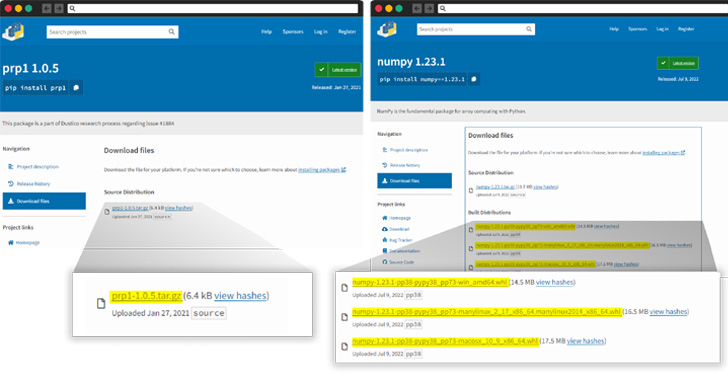
In other words, the command can be used to download a Python
package without having to install it on the system. But as it turns
out, executing the download command also runs the aforementioned
“setup.py” script, resulting in the execution of malicious code
contained within it.
However, it’s worth noting that the issue occurs only when the
package contains a tar.gz file instead of a wheel (.whl) file,
which “cuts the ‘setup.py’ execution out of the equation.”
“Developers opting to download, instead of installing packages,
are reasonably expecting that no code will run on the machine upon
downloading the files,” Gelb noted, characterizing it as a design
issue[5] rather than a bug.
Although pip defaults to using wheels instead of tar.gz files,
an attacker could take advantage of this behavior to intentionally
publish python packages without a .whl file, leading to the
execution of the malicious code present in the setup script.
“When a user downloads a python package from PyPi, pip will
preferentially use the .whl file, but will fall back to the tar.gz
file if the .whl file is lacking,” Gelb said.
The findings come as the U.S. National Security Agency (NSA),
along with the Cybersecurity and Infrastructure Security Agency
(CISA) and the Office of the Director of National Intelligence
(ODNI), released guidance[6]
for securing the software supply chain.
“As the cyber threat continues to become more sophisticated,
adversaries have begun to attack the software supply chain, rather
than rely on publicly known vulnerabilities,” the agency said[7]. “Until all DevOps are
DevSecOps, the software development lifecycle will be at risk.”
References
- ^
said
(medium.com) - ^
pip
install (pip.pypa.io) - ^
setup
script (docs.python.org) - ^
pip
download (pip.pypa.io) - ^
design
issue (github.com) - ^
released
guidance (media.defense.gov) - ^
said
(www.nsa.gov)
Read more https://thehackernews.com/2022/09/warning-pypi-feature-executes-code.html