A new highly capable and persistent threat actor has been
targeting major high-profile public and private entities in the
U.S. as part of a series of targeted cyber intrusion attacks by
exploiting internet-facing Microsoft Internet Information Services
(IIS[1]) servers to infiltrate
their networks.
Israeli cybersecurity firm Sygnia, which identified the
campaign, is tracking the advanced, stealthy adversary under the
moniker “Praying Mantis” or “TG2021.”
“TG1021 uses a custom-made malware framework, built around a
common core, tailor-made for IIS servers. The toolset is completely
volatile, reflectively loaded into an affected machine’s memory and
leaves little-to-no trace on infected targets,” the researchers
said[2]. “The threat actor also
uses an additional stealthy backdoor and several post-exploitations
modules to perform network reconnaissance, elevate privileges, and
move laterally within networks.”
Besides exhibiting capabilities that show a significant effort
to avoid detection by actively interfering with logging mechanisms
and successfully evading commercial endpoint detection and response
(EDR) systems, the threat actor has been known to leverage an
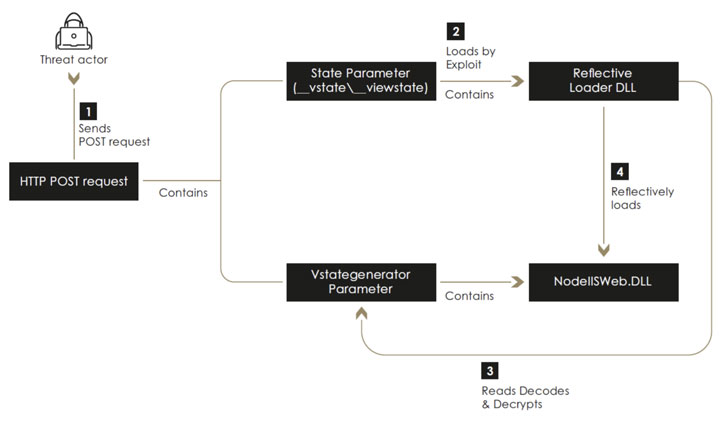
arsenal of ASP.NET web application exploits to gain an initial
foothold and backdoor the servers by executing a sophisticated
implant named “NodeIISWeb” that’s designed to load custom DLLs as
well as intercept and handle HTTP requests received by the
server.
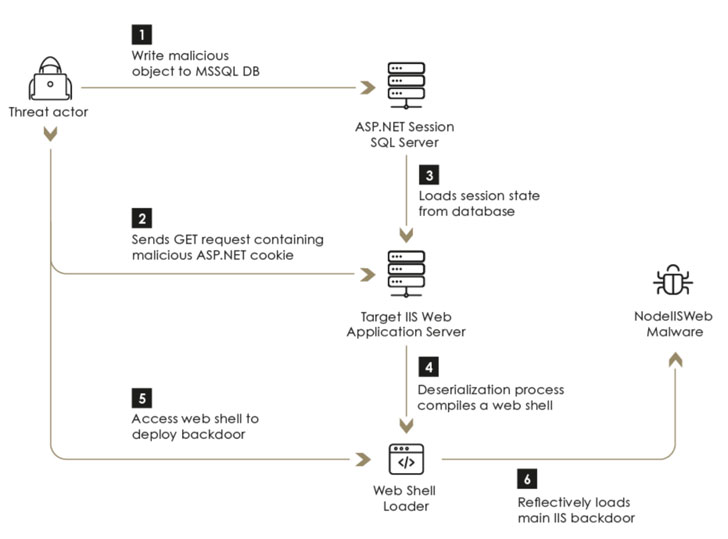
The vulnerabilities are taken advantage of by the actor
include:
Interestingly, Sygnia’s investigation into TG1021’s tactics,
techniques, and procedures (TTPs) have unearthed “major overlaps”
to those of a nation-sponsored actor named “Copy-Paste Compromises[3],” as detailed in an
advisory released by the Australian Cyber Security Centre (ACSC) in
June 2020, which described a cyber campaign targeting public-facing
infrastructure primarily through the use of unpatched flaws in
Telerik UI and IIS servers. However, a formal attribution is yet to
be made.
“Praying Mantis, which has been observed targeting high-profile
public and private entities in two major Western markets,
exemplifies a growing trend of cyber criminals using sophisticated,
nation-state attack methods to target commercial organizations,”
the researchers said. “Continuous forensics activities and timely
incident response are essential to identifying and effectively
defending networks from attacks by similar threat actors.”