
botnet campaign that is currently brute-forcing more than 1.5
million publicly accessible Windows RDP servers on the Internet.
Dubbed GoldBrute, the botnet scheme has been designed in
a way to escalate gradually by adding every new cracked system to
its network, forcing them to further find new available RDP servers
and then brute force them.
To fly under the radar of security tools and malware analysts,
attackers behind this campaign command each infected machine to
target millions of servers with a unique set of username and
password combination so that a targeted server receives brute force
attempts from different IP addresses.
The campaign, discovered by Renato Marinho at
Morphus Labs, works as shown in the illustrated image, and its
modus operandi has been explained in the following steps:
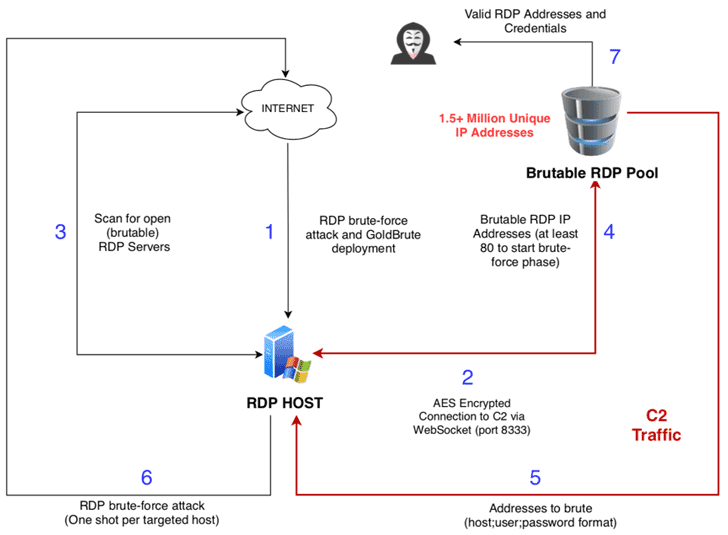
server, the attacker installs a JAVA-based GoldBrute botnet malware
on the machine.
Step 2 — To control infected machines, attackers utilize
a fixed, centralized command-and-control server that exchanges
commands and data over an AES encrypted WebSocket connection.
Step 3 and 4 — Each infected machine then receives its
first task to scan and report back a list of at least 80 publicly
accessible new RDP servers that can be brute-forced.
Step 5 and 6 — Attackers then assign each infected machine
with a unique set of username and password combination as its
second task, forcing them to attempt it against the list of RDP
targets the infected system continually receives from the C&C
server.
Step 7 — On successful attempts, the infected machine
reports back login credentials to the C&C server.
At this moment, it is unclear exactly how many RDP servers have
already been compromised and participating in the brute force
attacks against other RDP servers on the Internet.

around 2.4 million Windows RDP servers can be accessed on the
Internet, and probably more than half of them are receiving brute
force attempts.
Remote Desktop Protocol (RDP) made headlines recently for two
new security vulnerabilities—one was patched by Microsoft, and the
other still remains unpatched.
Dubbed BlueKeep, the patched vulnerability
(CVE-2019-0708) is a wormable flaw that could allow remote
attackers to take control of RDP
servers[2] and if successfully
exploited, could cause havoc around the world, potentially much
worse than what WannaCry[3] and NotPetya[4] like wormable attacks
did in 2017.
The unpatched
vulnerability[5]
resides in Windows that could allow client-side attackers to bypass
the lock screen on remote desktop (RD) sessions.
References
- ^
discovered
(morphuslabs.com) - ^
control of RDP servers
(thehackernews.com) - ^
WannaCry
(thehackernews.com) - ^
NotPetya
(thehackernews.com) - ^
unpatched vulnerability
(thehackernews.com)
Read more http://feedproxy.google.com/~r/TheHackersNews/~3/JnNQaHJknfI/windows-rdp-brute-force.html