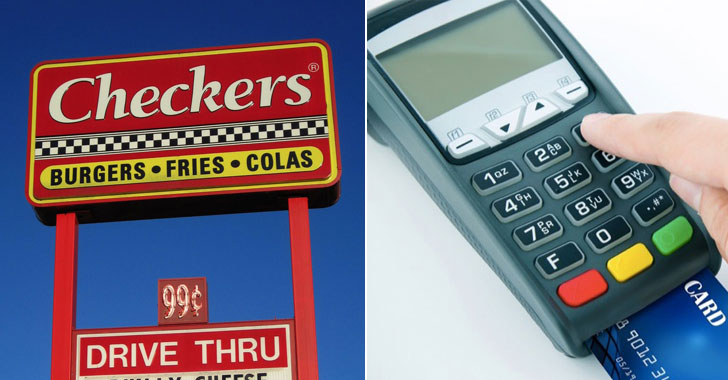
and Rally’s drive-through restaurant chains in past 2-3 years, you
should immediately request your bank to block your card and notify
it if you notice any suspicious transaction.
Checkers, one of the largest drive-through restaurant chains in
the United States, disclosed[1]
a massive long-running data breach yesterday that affected an
unknown number of customers at 103 of its Checkers and Rally’s
locations—nearly 15% of its restaurants.
The impacted restaurants [name, addresses and
exposure dates] reside in 20 states, including Florida,
California, Michigan, New York, Nevada, New Jersey, Florida,
Georgia, Ohio, Illinois, Indiana, Delaware, Kentucky, Louisiana,
Alabama, North Carolina, Pennsylvania, Tennessee, West Virginia and
Virginia.
[2]
After becoming aware of a “data security issue involving malware”
at some Checkers and Rally’s locations, the company launched an
extensive investigation which revealed that unknown hackers managed
to plant malware on its point-of-sale (PoS) systems across 103
stores.
The PoS malware was designed to collect information stored on
the magnetic stripe of payment cards, including cardholder’s name,
payment card number, card verification code, and expiration
date.
However, the company pointed out that the investigation found no
evidence suggesting that hackers made off with additional
information belonging to the affected cardholders, and that “not
all guests who visited the listed restaurants” are affected by the
breach.
According to the exposure dates mention on the list of impacted
restaurants:
- One restaurant in California had PoS malware installed on its
system in December 2015, which continually captured customers
payment card information until March 2018. - Two restaurants, one in California and other in Florida, were
backdoored with the PoS malware in 2016, allowing hackers to
remotely steal until 2018 and 2019, respectively. - Four restaurants in four different states were infected in 2017
and remained infected between early 2018 and 2019. - Remaining restaurants were infected in 2018 and remained active
until early 2019.
The restaurant chain assured its customers that the company
worked closely with the third-party data security experts to
contain and remove the malware upon discovering the security
incident.
Additionally, the company is also “working with federal law
enforcement authorities and coordinating with the payment card
companies in their efforts to protect cardholders,” and “continue
to take steps to enhance the security of Checkers and Rally’s
systems and prevent this type of issue from happening again.”
The company recommends customers to check their billing
statements, order a credit report, and report any suspicious
incident to the Federal Trade Commission.
So, if you have visited any of the affected locations during its
exposure date, you are highly recommended to review your account
statements for suspicious transactions, and if come across any,
immediately contact the card issuer and consider placing a fraud
alert or security freeze on your credit file at Equifax[3], Experian[4], and TransUnion[5].
Also, if possible, you are advised to block the affected payment
card and request a new one from your respective financial
institution.
References
- ^
disclosed
(www.checkers.com) - ^
name, addresses and exposure dates
(www.checkers.com) - ^
Equifax
(www.equifax.com) - ^
Experian
(www.experian.com) - ^
TransUnion
(www.transunion.com)
Read more http://feedproxy.google.com/~r/TheHackersNews/~3/rD0lGuHt0tk/credit-card-checkers-restaurants.html