a detailed report on a widespread cryptojacking campaign attacking
Windows MS-SQL and PHPMyAdmin servers worldwide.
Dubbed Nansh0u, the malicious campaign is reportedly
being carried out by an APT-style Chinese hacking group who has
already infected nearly 50,000 servers and are installing a
sophisticated kernel-mode rootkit on compromised systems to prevent
the malware from being terminated.
The campaign, which dates back to February 26 but was first
detected in early-April, has been found delivering 20 different
payload versions hosted on various hosting providers.
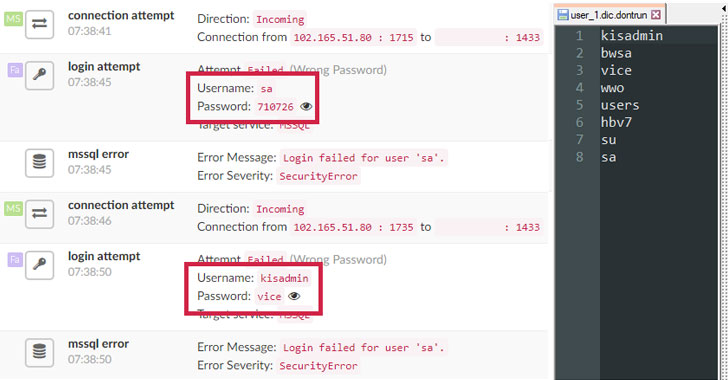
The attack relies on the brute-forcing technique after finding
publicly accessible Windows MS-SQL and PHPMyAdmin servers using a
simple port scanner.
Upon successful login authentication with administrative
privileges, attackers execute a sequence of MS-SQL commands on the
compromised system to download malicious payload from a remote file
server and run it with SYSTEM privileges.
In the background, the payload leverages a known privilege
escalation vulnerability (CVE-2014-4113) to gain SYSTEM privileges
on the compromised systems.
“Using this Windows privilege, the attacking exploit injects code
into the Winlogon process. The injected code creates a new process
which inherits Winlogon SYSTEM privileges, providing equivalent
permissions as the prior version.”
compromised servers to mine TurtleCoin cryptocurrency.
Besides this, the malware also protects its process from
terminating using a digitally-signed kernel-mode rootkit for
persistence.
“We found that the driver had a digital signature issued by the top
Certificate Authority Verisign. The certificate – which is expired
– bears the name of a fake Chinese company – Hangzhou Hootian
Network Technology.”
IoCs[2] (indicators of
compromise) and a free PowerShell-based
script[3] that Windows
administrators can use to check whether their systems are infected
or not.
Since the attack relies on a weak username and password
combinations for MS-SQL and PHPMyAdmin servers, admins are advised
to always keep a strong, complex password for their
accounts.
References
- ^
published
(www.guardicore.com) - ^
list of IoCs
(github.com) - ^
PowerShell-based script
(github.com)
Read more http://feedproxy.google.com/~r/TheHackersNews/~3/5U7cyftK9WE/hacking-mysql-phpmyadmin.html