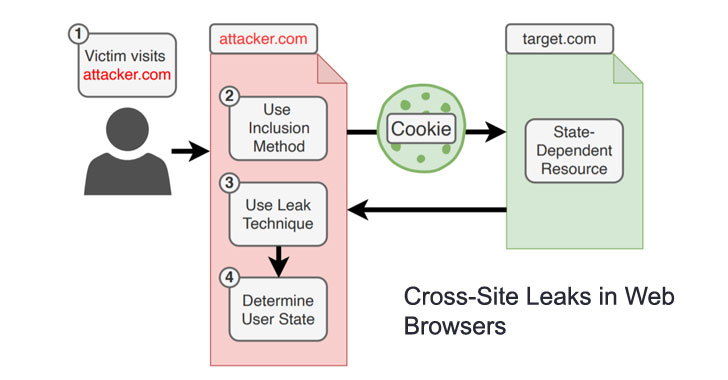
Researchers have discovered 14 new types of cross-site data
leakage attacks against a number of modern web browsers, including
Tor Browser, Mozilla Firefox, Google Chrome, Microsoft Edge, Apple
Safari, and Opera, among others.
Collectively known as “XS-Leaks,” the browser bugs enable a
malicious website to harvest personal data from its visitors as
they interact with other websites in the background without the
targets’ knowledge. The findings[1]
are the result of a comprehensive study of cross-site attacks
undertaken by a group of academics from Ruhr-Universität Bochum
(RUB) and Niederrhein University.
“XS-Leaks bypass the so-called same-origin policy[2], one of a browser’s main
defences against various types of attacks,” the researchers
said[3]
in a statement. “The purpose of the same-origin policy is to
prevent information from being stolen from a trusted website. In
the case of XS-Leaks, attackers can nevertheless recognize
individual, small details of a website. If these details are tied
to personal data, those data can be leaked.”
Stemming from side-channels built into the web platform that
permits an attacker to gather this data from a cross-origin HTTP
resource, the cross-site bugs impact an array of popular browsers
such as Tor, Chrome, Edge, Opera, Safari Firefox, Samsung Internet,
spanning across different operating systems Windows, macOS,
Android, and iOS.
The new class of vulnerabilities is also different from a
cross-site request forgery (CSRF[4]) attack in that unlike
the latter, which exploits a web application’s trust in a browser
client to execute unintended actions on behalf of the user, they
can be weaponized to infer information about a user.
“They are a significant threat to Internet privacy since simply
visiting a web page may reveal if the victim is a drug addict or
leak a sexual orientation,” the researchers explained[5]. “XS-Leaks take
advantage of small pieces of information which are exposed during
interactions between websites […] to reveal sensitive information
about users, such as their data in other web applications, details
about their local environment, or internal networks they are
connected to.”
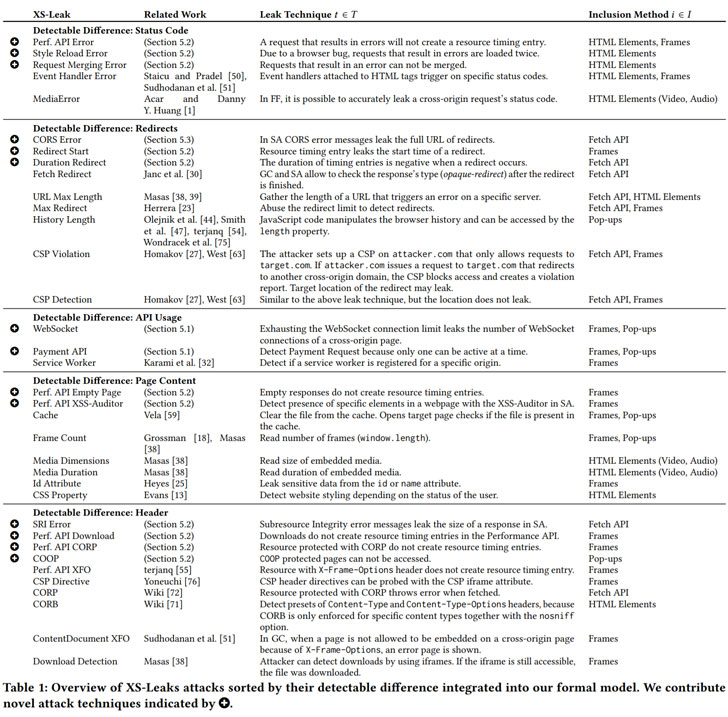
The core idea is that while websites are not allowed to directly
access data (i.e., read server responses) on other websites because
of same-origin constraints, a rogue online portal can attempt to
load a specific resource or an API endpoint from a website, say, an
online banking website, on the user’s browser and draw inferences
about the victim’s transaction history. Alternatively, the source
of the leak could be timing-based side-channels or speculative
execution attacks like Meltdown[6]
and Spectre[7].
As mitigations, the researchers recommend denying all event
handler messages, minimizing error message occurrences, applying
global limit restrictions, and creating a new history property when
redirection occurs. At the end-user side, turning on first-party isolation[8]
as well as Enhanced Tracking Prevention in Firefox have been found
to decrease the applicability of XS-Leaks. Intelligent Tracking
Prevention in Safari, which blocks third-party cookies[9] by default, also
prevents all leaks that are not based on a pop-up.
“The root cause of most XS-Leaks is inherent to the design of
the web,” the researchers said[10]. “Oftentimes
applications are vulnerable to some cross-site information leaks
without having done anything wrong. It is challenging to fix the
root cause of XS-Leaks at the browser level because in many cases
doing so would break existing websites.”
References
- ^
findings
(xsinator.com) - ^
same-origin policy
(developer.mozilla.org) - ^
said
(news.rub.de) - ^
CSRF
(owasp.org) - ^
explained
(xsinator.com) - ^
Meltdown
(thehackernews.com) - ^
Spectre
(thehackernews.com) - ^
first-party isolation
(www.ghacks.net) - ^
blocks
third-party cookies (webkit.org) - ^
said
(xsleaks.dev)
Read more https://thehackernews.com/2021/12/14-new-xs-leaks-cross-site-leaks.html